How ADL’s Partisanship Harms the Fight Against Antisemitism

Originally published in The Daily Signal

For over a century, the Anti-Defamation League has enjoyed a reputation as the preeminent Jewish organization combating antisemitism and all forms of hate. Its acronym, ADL, has “household name” status—and not just in Jewish homes. This makes its current penchant for partisanship extraordinarily dangerous for, and beyond, the Jewish community.

Last December, Senate Republicans learned that a Joe Biden nominee for a lifetime judicial appointment, Adeel Mangi, was previously a board member and generous supporter of the antisemitic Center for Security, Race and Rights at Rutgers University Law School. At his confirmation hearing, they questioned Mangi about his alarming affiliation with that center and his knowledge of its repugnant activities. Just last week, proof emerged that Mangi had worked closely with the center’s director and others with ties to antisemitism and terror.

Yet rather than applaud the senators’ concern, the ADL stunningly accused them of bigotry. It decried the supposed “inappropriate and prejudicial treatment” of Mangi that appeared to be “motivated by bias towards his religion”—Islam. Mangi’s faith and ethnicity were never mentioned in the questions, in contrast to the activities and ideology of the center.

For daring to question a nominee’s association with anti-Jewish bias, the ADL accused Republican senators of anti-Muslim bias. One could hardly imagine a more outrageous betrayal of the ADL’s historic mission.

Yet this was no rare instance of the ADL leveling a politically charged but fundamentally wrong indictment. Rather, sectarianism permeates the organization, especially since Jonathan Greenblatt left the Obama Administration to become its CEO in 2015.

Greenblatt’s background is notably lacking in advanced Jewish education, specifically regarding how Judaism itself has, for millennia, consistently identified antisemitism, the world’s “longest hatred,” using a neutral yardstick. He has surrounded himself with like-minded progressives, such that today’s ADL views antisemitism, like everything else, through a partisan lens.

In a post to Elon Musk’s X platform, Greenblatt recently lumped “neo-Nazis at CPAC” (the Conservative Political Action Conference) together with antisemitic rants by Nation of Islam leader Louis Farrakhan and delinquents who verbally assaulted writer Bari Weiss and Jerry Seinfeld in Manhattan.

CPAC declared that it stands with Israel, offered plenary sessions on antisemitism and the hostages held by Hamas, and has for years sponsored a “Shabbat at CPAC” program for observant Jews. To associate it with the very people it bans from attending, much less speaking, is simply deplorable—and consequential. It alienates the millions of Americans who support CPAC and its policy positions while blunting the efforts by CPAC’s leaders to combat antisemitism.

And speaking of Musk, Greenblatt wondered if Twitter, as it was known at the time, should be shut down after Musk restored Donald Trump’s access to the platform. Apparently, Greenblatt shared the opinion of X’s previous owners, who thought Trump’s tweets were hateful, but deemed Iran’s Ayatollah Ali Khamenei’s calls for Jewish genocide merely “foreign policy saber-rattling.”

This bears no resemblance to nonpartisan concern for antisemitism. The results were predictable: Musk is no antisemite, but his response to this gratuitous attack inadvertently elevated one.

So anxious is the ADL to malign conservatives that it even targets Jews who favor traditional values. Last year, the ADL’s Center on Extremism took aim at Chaya Raichik, the Orthodox Jewish woman behind Libs of TikTok; it tarred her as a purveyor of “anti-transgender hate” until Raichik threatened to sue. The ADL immediately quailed, conceding by implication that its accusations were indefensible.

Yet in November, the same Center on Extremism published a similar hit piece on the National Center for Public Policy Research and the National Legal and Policy Center. These organizations criticize supranational organizations like the U.N. and the World Economic Forum and what they call “globalist” agendas.

Although the ADL readily admitted that the “globalist” language was consistent with what “mainstream personalities and politicians” use and that “there is no evidence to suggest that either organization’s … proposals were filed with antisemitic intentions,” the ADL insisted nonetheless that the word globalist “could be interpreted” (emphasis added) as “an antisemitic dog whistle,” along with “conspiracy theories” that “sometimes promote antisemitism” (emphasis added).

Rather than learning to focus upon accuracy after the Raichik debacle, the ADL seems to have learned to employ weasel words to evade legal culpability.

This is especially offensive considering that one of the ADL’s named targets, the National Center for Public Policy Research’s Ethan Peck, is another Jew, an Israeli-American who condemns globalists in part for funding the United Nations Relief and Works Agency for Palestine Refugees. The relief agency, of course, was lavishly funded from around the world as it taught Arab schoolchildren to murder Jews until the Israelis recently proved that the agency provided electrical power, internet connectivity, support, and terrorists for Hamas.

If the ADL truly believes Peck is blowing an antisemitic dog whistle, the problem is ADL’s hearing, not the decent, respected, and philo-semitic National Center for Public Policy Research. But given the careful language choices the ADL uses to smear Peck and his organization, it honestly appears more likely that the ADL knew its charges were specious from the outset.

The weaponized sectarianism of the ADL’s national headquarters undermines the fight against Jew-hatred, including efforts by its less ideology-driven (and thus, more effective) local offices to engage with law enforcement, legislators, and the public. This is true, first of all, because those on the disfavored side are silenced: How can Peck be a credible advocate for Jews and their indigenous rights while the ADL implies that the organization he serves is spreading antisemitic tropes?

And, still more dangerously, the ADL’s silence and even expressed tolerance for left-wing antisemitism permits that antisemitism to fester. The ADL legitimized groups like Black Lives Matter organizations that promoted antisemitic tropes until BLM’s reaction to Hamas’ attack on Israel on Oct. 7 made this untenable. Until Whoopi Goldberg claimed the Holocaust wasn’t about race, the ADL’s own definition of racism attributed it uniquely to whites. All of this was happening while the most-targeted demographic in history—the one the ADL was created to defend—was smeared by leftist antisemites as possessing “white privilege.”

Greenblatt is now confronted by a reality quite different from his ideology. It was not conservatives who disrupted his speech at Brown University about antisemitism. And, of course, to the Mangi-supported, antisemitic Rutgers Center, the ADL remains a den of reviled “Zionists.” The center’s director, Sahar Aziz, obtusely accused the ADL of “aligning itself with right-wing leaders.” Just last month, when the ADL pointed out correctly that American student groups were supporting Hamas, the center denounced the ADL for engaging in “anti-Palestinian advocacy.”

The Coalition for Jewish Values, where I serve as managing director, is one of several organizations calling out antisemitism on both sides of the political aisle. The ideological tilt of the ADL harms both our and its own efforts, and this can no longer be ignored. While our Jewish communities are surrounded by real wolves, it is unconscionable that the ADL continues to cry wolf, wounding those favorably disposed toward Jews and Israel while true antisemites endanger America’s future.


Religious Liberty Stops Violence

Originally published in Newsweek

By Jeremy Dys and Rabbi Yaakov Menken

Americans, rightly horrified, watch the ongoing violence in Israel while, close to home, a nefarious wave of intolerance spreads. Only a commitment to freedom will stop the spread of violence.

According to just-released FBI data, Jewish Americans faced 1,305 incidents meriting the label of “hate crime” in 2022. That was up from 817 in the prior year. Violence toward American Jews ranged from destruction of property and vandalism (775 cases) to intimidation (358) to simple and violent assault (141).

No religious group faced more intolerance in 2022 in America, according to these statistics. Anti-Muslim sentiment was the next closest with 205 documented reports of anti-Muslim hate crimes.

Such intimidation of religious people undermines the promise of the free exercise of religion guaranteed by the U.S. Constitution. Hatred and harassment toward those peacefully exercising their religion is evil and must be overcome with good. Anyone intimidating or harassing those peacefully practicing their religion must be condemned in the strongest terms possible—lest intimidation and harassment turn to violence.

Violent antisemitism should be opposed regardless of where on the globe it occurs. In America, it flows from the breakdown of religious liberty. Thus, while Americans may disagree over religion, there should be no disagreement on our buttressing the free exercise of religion for all people.

Cases of destruction of Jewish-owned property and the vandalism of synagogues, for instance, do not materialize overnight. Take the experience of our client and friend, respectively, Rabbi Yaakov Rich and Congregation Toras Chaim. In the suburbs of Dallas, Texas, Rabbi Rich sought to use his home to host religious gatherings of Orthodox Jews. But his neighbors viewed him with suspicion. The homeowners association sued him, trying to prevent his religious meetings. While the association took legal action, someone spray-painted a swastika on the Rabbi’s car.

Official intolerance demonstrated by the homeowners association led to aggression and vandalism by an individual.

In California, animal rights activists filed a slew of lawsuits to prevent the ancient Jewish tradition of Kapparot—a religious rite in which Orthodox Jews contemplate the atonement of their sins through the Kosher and humane killing of a chicken. While First Liberty Institute worked to prevent efforts to end the millennia-old religious tradition in the Ninth Circuit, emboldened activists vandalized Los Angeles’ Hebrew Discovery Center, splattering it with red paint and throwing bricks at the property.

Lawfare targeting an ancient tradition that survived the Babylonian exile and the Roman occupation of Israel gave cover for individuals to use violence and intimidation against the Jewish people of Los Angeles.

“The Citizens of the United States of America have a right to applaud themselves for having given to mankind examples of an enlarged and liberal policy: a policy worthy of imitation,” wrote President George Washington to the Hebrew Congregation of Newport, Rhode Island. America’s commitment to freedom—and religious freedom in particular—has, in past days, quelled violence and intimidation toward “the Children of the Stock of Abraham, who dwell in this land,” giving “bigotry no sanction, to persecution no assistance,” as Washington wrote.

Only that same commitment to religious liberty will keep disagreement from boiling over to intolerance, intimidation, and worse.

It is in times of darkness that the flame of liberty must be our guiding light. Thus, we join the prayer of our first president: “May the father of all mercies scatter light and not darkness in our paths, and make us all in our several vocations useful here, and in his own due time and way everlastingly happy.”

Photo Credit: Wikimedia

Why Calling For Israel’s ‘Restraint’ Is Depraved And Offensive

Originally published in The Federalist

Just as happened 50 years ago, radical Islamic forces launched a murderous assault against the world’s only Jewish state on a Holy Day on the Jewish calendar. They knew Jews would be busy at prayer and holiday observances, making the surprise that much worse. And to say they acted like animals is inaccurate only in that animals are incapable of the level of depravity they proudly recorded on video.

Barring a life-threatening emergency, observant Jews do not use electronics or telephones during the Sabbath and holidays — so although reports of the attack trickled through the Jewish community here in America, we were unable to read the news until Sunday evening. There was one thing, though, I knew to expect: calls for “restraint.” They come after each terrorist atrocity against Israel, and this case was no different.

Hamas, of course, never acts with restraint. Restraint entails, among other things, trying to avoid killing civilians, and Hamas targets civilians. What spokesmen for Egypt, the UAE, Russia, China, Australia, South Africa, and the UN secretary-general have called for, then, is “restraint” in Israel’s response to the worst massacre of Jews since the Nazi Holocaust. Rep. Alexandria Ocasio-Cortez and her colleague Rep. Cori Bush used a still more offensive term: “de-escalation.”

These calls are not merely inappropriate and one-sided, but genuinely evil. This pogrom transpired precisely because Israel was pressured into listening to previous calls for “restraint.”

Think about it: Not once have world leaders called for restraint from Ukraine. History records no cries for de-escalation as British and American bombers reduced Dresden to rubble while fighting the Nazis, allied forces pummeled Iraq, or American troops hunted Osama bin Laden. Nor should there have been. None of the aforementioned world leaders or members of Congress call for restraint when fighting totalitarians or terrorists — unless the victims are Jews.

Tellingly, the documentary series “The Unauthorized History of the Vietnam War,” pillories President Lyndon Johnson’s war policy as “fatal restraint.” Restraint is how you lose wars. Restraint is how you allow a vicious enemy, driven by hate, to rebuild its capabilities and learn new and crueler ways to inflict violence and terror.

Here’s another word bound to come up in the coming days: “proportionality.” A correct, moral “proportion” is for every terrorist to be neutralized, with minimal casualties among their intended civilian targets. Yet global media sources routinely denounce Israel for not permitting the number of Jews killed to equal or exceed the number of terrorists and their supporters dispatched. It should sicken anyone with a functioning moral compass.

Actually, it does sicken anyone with a functioning moral compass. It’s just that you find precious few such people at MSNBC or The New York Times.

And a third depraved cliché: “cycle of violence.” The only cycle here is that of Arab terrorists murdering Jews, and Israel responding to protect its civilians. It is both repugnant and ridiculous to portray this as a two-sided battle. Was there a “cycle of violence” in the Warsaw Ghetto?

A famous Talmudic dictum from R’ Elazar says that one who is compassionate to the cruel will, in the end, be cruel to the compassionate. This has immediate applicability when Hamas has, since 2006, had majority support in the moral sewer that is Gaza, and Hamas has now taken the elderly, women, and toddlers captive — in addition to those raped, murdered, and dragged through the streets.

In the current situation, the innocent captives should be the next to cross the border between Israel and Gaza, safe and unharmed. To provide Gazans with not merely transit into Israel, but electricity, fuel, and even basic supplies is not merely unacceptable, but reprehensible. It is the responsibility of Hamas, not Israel, to provide these things, and it is overdue for the populace to learn that support for genocidal barbarians is not without costs.

In actuality, it goes far beyond that. Israel made a horrible mistake in 2006 when it “disengaged” from Gaza, pulling thousands of Jews from their homes. The idea of a peaceful Arab government in that territory was pure delusion, and, of course, proponents insisted it would never be a source of terror — and that Israel would re-occupy that territory if it were ever to attack. Israel repeatedly failed to do precisely that, as Hamas and Palestinian Islamic Jihad repeatedly launched unprovoked attacks from Gaza.

Israel must fail no longer. Referring to Hamas, Netanyahu claimed Israel would “defeat them to the end,” but mollified this by saying Israel would destroy the “capabilities” of Hamas. No. The presence of Hamas alongside Israel places every Israeli civilian in jeopardy; it is far overdue for that danger to be removed. Israel must utterly destroy Hamas, and this war cannot end until the white flag of surrender flies from the pile of concrete that was once the Hamas center of operations.

Anything else would be a moral failing of disastrous proportions, one that will surely bring future horrors in its wake.

Progressive Myopia Inflames Antisemitism

Originally published in Newsweek

Less than a century after the Holocaust, antisemitism is sweeping across America to a degree unimaginable a few decades ago. Though just two percent of the U.S. population, Jews are the most targeted religious group in America. An identifiably Jewish person is several times more likely than a member of any other minority to be a victim of a hate crime. But don’t expect to hear this from DEI officials; many of them are guilty of antisemitic bias themselves.

That well-paid diversity advocates pronounce Jews, those whom the Nazis massacred for being non-white, to be beneficiaries of “white privilege” is only one symptom of the underlying disease. Wilful blindness to left-wing hate has allowed it to fester.

Recognizing antisemitism is not always easy. It disguises itself behind facades that grant it respectability in different societies and cultures. It is the grandfather of all conspiracy theories, and the untrained ear will often confuse antisemitic bias with legitimate opinion and vice versa.

In Christian Europe, of course, that disguise was religion itself. The Enlightenment demanded a new, “intellectual” rationale, and “Anti-semitism”—the academic study of Jews’ purportedly inferior ethnicity—came into vogue. Today, of course, barefaced racism no longer has a cultural purchase; society’s supreme concern is respect for human rights. But this noble cause has been derailed, like religion and science before it, by antipathy towards Jews.

Modern definitions of antisemitism share predictable flaws: first, they often focus on the aforementioned facades rather than on the underlying hate. Still worse, they can be accused, accurately or not, of partisan bias. And finally, as the late Rabbi Lord Jonathan Sacks observed, “most antisemites do not think of themselves as antisemites.” In other words, antisemites will define antisemitism in ways that exonerate their own bigotry. Even those who dispute hateful positions may not recognize that they are opposing a familiar evil.

Classical Jewish thought, by contrast, removes the masks and identifies the underlying lies that antisemites tell themselves. Rabbi Naftali Z.Y. Berlin, dean of the foremost Rabbinic school at the end of the 19th century, specified two core superstitions: the idea that all Jewish property is stolen via fraud and deceit and that Jews, deeming themselves superior, denigrate and harm everyone else.

These two red flags are unambiguous. Given that Rabbi Berlin passed away decades before Adolf Hitler rose to power, no one can accuse him of political partisanship. His intent was merely to inform Jews regarding the hatred they faced.

This brings us to something I call the Promised Land paradox. The story of the Promised Land is part of common parlance. Everyone knows what it is, where it is, and to whom it was promised—and how central it is to the faith of Moses and the Jewish people. Yet millions of Americans, including many who claim to value both religious tolerance and human rights, have adopted a fictional narrative built upon a European colonialist term for that Jewish homeland: Palestine. To the community of Rabbinic scholars, the source of this revisionist history is sadly familiar.

In this alternate reality, descendants of Arab marauders are “indigenous Palestinians,” whose homeland, by miraculous coincidence, happens to trace the borders of modern Israel. The Jews, in other words, are “stealing” Judea, precisely as Rabbi Berlin predicted.

Note, by the way, that “Palestinians” referred to Jews for over 2,000 years. There was no sizable Arab population in the Holy Land when the Palestinian Talmud was written, and even in the 1930s, the “Palestinian” soccer uniform featured the Star of David. Today, “Palestinian” is used to racially exclude those same Jews and to call them “colonialists” for returning home.

Despite multiple attempts by Arab armies to repeat the Nazi genocide in modern Israel, Israel provides its Arab citizens with superior health care, higher education, and the right to vote. Yet it is demonized with words like “oppression,” “brutality,” and “ethnic cleansing.” This is incomprehensible without recourse to Rabbi Berlin’s trenchant observation: antisemites consider Jews inherently bigoted against others.

There is no debate among Rabbinic scholars, even those who steadfastly oppose modern Zionism, that boycotts of Israel for alleged theft of “Palestinian” land are rooted in classic antisemitism. Those who claim otherwise are at least ignorant, if not worse, about antisemitism and its manifestations.

In the end, it is insufficient merely to deny that Israel is a racist, apartheid state. The reality is that only a racist would call Israel an apartheid state—a racist of a particularly malignant and dangerous form.

Political scientist Joseph Overton posited that in every society there is a range, or window, of acceptable ideas. Rabbi Sacks said that antisemitism, or any hate, becomes dangerous in a democracy when it moves from the fringes into a mainstream party, the party’s reputation is not harmed, and those who protest it are vilified. He was not speaking about America, but his words apply today: hatred of Jews, when expressed against Jewish self-determination in the Jewish homeland, has moved into the Overton window—and into Congress.

For all the initiatives that have and can be taken against antisemitism, the most crucial is to restore the Overton window to a humane place.

In early 2019, former congressman Steve King was reported to have endorsed white supremacy. From that moment until he was voted out, he was persona non grata. It was nearly impossible for him to find cosponsors for proposed legislation.

By contrast, 10 Leftists in Congress recently endorsed racist bias against Israel, even boycotting Israel’s own left-wing president when he came to address them. Yet other Representatives, including several with outstanding records of fairness and friendship towards Jews and Israel of their own, have continued to cosponsor legislation from those 10.

That is what must change for the Overton window to again encompass only positions compatible with a civilized society. Congress must, in a bipartisan fashion, repudiate racism in its ranks—even when expressed against Jews.

Photo Credit: Ted Eytan

Nobody Wins in Musk vs. ADL

Originally published in The Daily Signal

By Rabbi Yaakov Menken and James Carafano

In the fight between Elon Musk and the Anti-Defamation League, Americans are the biggest losers. Antisemitism and woke politics are both cancers eating away at our civil society. We should be intolerant of both—and of those who ask us to pick a side.

For starters, America has seen a saddening trend of civil rights organizations taken over by partisan figures willing to misuse and tarnish institutional reputations for political benefit. These groups are so well-known that acronyms suffice: SPLC, ACLU, and, of course, ADL.

And because these American institutions are so prominent and respected, their recent, woke leaders presume that the credibility of their pronouncements will go unquestioned and that their targets quickly will quail.

ADL has drawn fire from Elon Musk and his X social media platform (formerly known as Twitter) because the organization’s CEO, Jonathan Greenblatt, attacked Musk first by calling his decisions alarming and a “threat to democracy.” Beyond that, ADL pressed X to censor political speech and went after its advertisers when Musk refused.

The Anti-Defamation League, founded in 1913, was for decades the go-to address to combat antisemitism and promote civil rights for all Americans. In recent years, though, the ADL has made itself the poster child for once-great organizations gone woke.

Though the slide to the Left began earlier, it gathered momentum when Greenblatt took over in 2015. Greenblatt sported a long resume of work for progressive causes, culminating in a stint as director of the White House Office of Social Innovation and Civic Participation during the Obama administration. However, he had no previous experience serving Jewish organizations or combating antisemitism.

To his credit, the ADL under Greenblatt has done much more to combat antisemitism expressed against Orthodox Jews, by far the most frequently targeted minority per capita in America today.

But at the same time, Greenblatt has taken a distinctly partisan approach to the problem, condemning conservatives who are innocent of real bias while giving a free pass to progressives who clearly are motivated by hate.

The ADL associates the Conservative Political Action Conference with bigotry and white supremacy—thus alienating millions of fair-minded Americans. CPAC is an annual gathering of conservative activists that offers an aligned “Shabbat at CPAC” program to facilitate attendance by observant Jews.

Only in 2021, on the other hand, did Greenblatt finally admit that “the Left has an antisemitism problem,” although that was obvious to impartial observers at least a decade earlier.

Antisemitism on Twitter (now X) didn’t start under Musk, but the ADL did little while the platform was controlled by progressives. Twitter stunned Israelis in 2020 when it placed warnings on tweets by then-President Donald Trump while Iran’s Ayatollah Ali Khamenei was calling Israel “a cancerous growth” to be “uprooted and destroyed.”

Trump, Twitter representatives intoned, engaged in “glorification of violence,” whereas calling for yet another genocide against Jews qualified as “comments on political issues of the day, or foreign policy saber-rattling on military and economic issues.”

At least publicly, the ADL said nothing when pre-Musk Twitter claimed that classic Jew-hatred is a legitimate political position. On the contrary: Greenblatt asked “is it time for Twitter to go?” in response to Musk’s reinstating Trump’s account, picking the fight playing out today.

The problem with Musk’s pushback, though, is that he built it upon #BantheADL, a hashtag created by Keith Woods, a white nationalist and self-proclaimed “raging antisemite.” Musk gave a “like” to the tweet in which Woods first used the hashtag, and the entrepreneur has continued to employ it in his own statements.

Perhaps Musk first thought “ban” was an exaggeration, similar to Greenblatt’s “is it time for Twitter to go?” But it is abundantly clear by now that Woods is not interested in free speech for all; on the contrary, he hopes to silence efforts to combat antisemitism.

Although Musk declared that “I’m pro-free speech, but against anti-Semitism of any kind,” a statement explicitly dissociating himself from the hatred expressed by Woods and the original fans of his hashtag is long overdue.

X has exploded with clearly hateful tweets favoring Musk while demonizing Jews, and Musk has yet to object to the enthusiastic support he now is receiving from both neo-Nazis and adherents of radical Islamist terror groups.

Beyond noting that it is grievously counterproductive to conflate opposing censorship with antisemitism, the rest of us must keep sight of the big picture. Wokeism opposes classic biblical values taught by Abraham and embraced by the Founding Fathers; so, of course, do antisemites. It is not merely possible, but crucial, that we reject both.

Advancing the idea that people are oppressed or privileged due to the color of their skin, in particular, provides an opening for hatred against Jews. Indeed, the woke claim that Arab Muslim immigrants are “of color” and therefore oppressed, while Jewish refugees ethnically cleansed from those same Arab states are “white” and therefore privileged. This is abhorrent.

Ultimately, it is our obligation to embrace equality of opportunity, the root and branch of American freedoms. No group in America should be treated differently than others, celebrated or demonized due to ethnic bias. We need neutral social media platforms where we can share ideas and argue policy freely, and honest, responsible civil society organizations that advance equality without political bias.

We can have all of those things, of course, without elevating the rantings of an antisemite. Choosing sides between the Anti-Defamation League and Elon Musk is the wrong approach; we must expect better from both.

Photo Credit: EU News

NYTimes smears Hasidim again… now, in Yiddish

Originally published in The Times of Israel

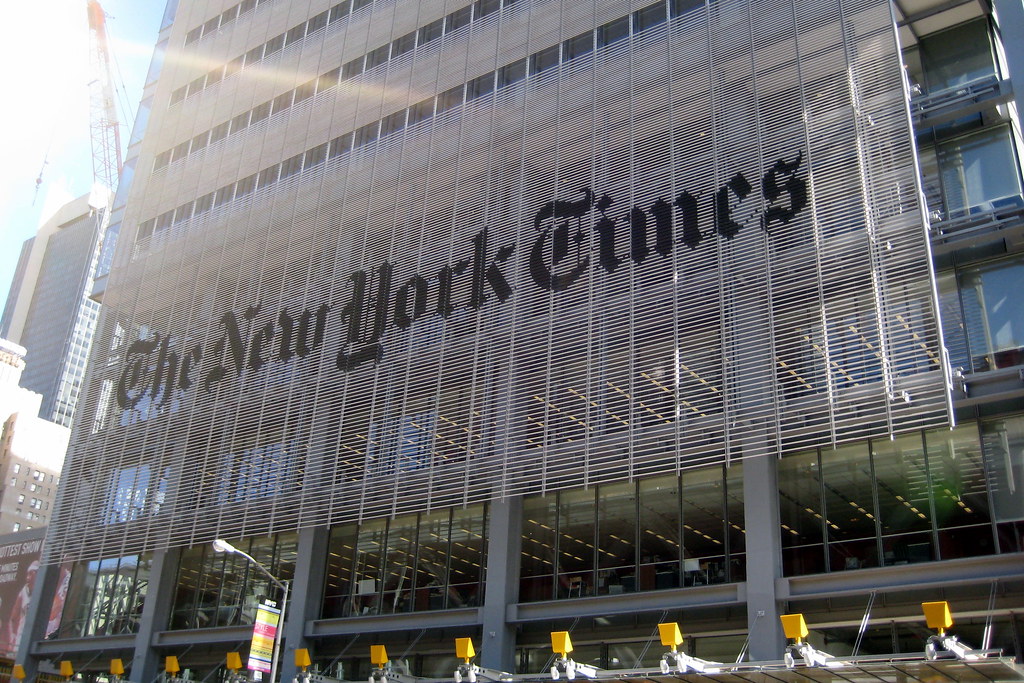
For months now, the New York Times has pursued a campaign to slander and defame Haredi Jews, primarily but not limited to Hasidim and the yeshiva education system. Most recently, the Times demonstrated that it is happy to print blatant pejorative falsehoods about Haredim, especially Hasidim, even when discussing, of all things, Yiddish. That the author of “Yiddish Is Having a Moment” is a professor at Amherst College, Ilan Stavans, only makes the display of ignorance and animus that much more embarrassing.

The untruths begin at the beginning, as he claims that Yiddish, “a language without a physical address,” has “come frighteningly close to extinction.” Stavans ignores the obvious connection between Yiddish and Jews, who for nearly two thousand years had no physical address and were relentlessly persecuted, and were murdered by the millions less than a century ago.

Yiddish was the lingua franca of European Jewry and remains so for Hasidic Jews today. At no time was Yiddish at any unique threat of extinction, at greater danger than Jews themselves.

It is not Yiddish that has survived, rebuilt, and thrived – it is the Orthodox Jewish community. But to point out that the use of Yiddish has consistently tracked the exponential growth of the Hasidic population would contradict the author’s narrative that Yiddish is only now “having a moment.” To Stavans, Yiddish is only relevant if it is being used by non-Hasidim, no matter the burgeoning Hasidic community that speaks Yiddish as their first language.

This is all the more bizarre when one considers that each and every example he touts of Yiddish appearing in modern entertainment concerns a show or film about Hasidim. As the Hasidic community has grown, so has curiosity about its unique lifestyle – and entertainment writers have responded with pieces offering greater and lesser accuracy in their portrayals, as well as lesser and greater bias against the community they claim to depict. (Also notable: at a time of great emphasis on “diversity,” no one has suggested that a Hasidic character ought to be portrayed by an actual Hasid. But I digress.)

Stavans suggests that the use of Yiddish is somehow tied to secular Jews before the Holocaust and that its use primarily by Hasidim today reflects a decline. This is inane: as he himself writes, Yiddish dates back at least to the Twelfth Century of the Common Era, a time when essentially all Jews practiced Judaism. Early secular Jews used Yiddish for no other reason than that they all came from religious homes.

For well over two-thirds of its history, Yiddish was almost exclusively spoken by deeply religious Jews, and that is increasingly true once again now that secular (and even non-Hasidic Orthodox) Jews primarily speak the languages of the countries in which they reside. Identifying Yiddish as a secular Jewish language is no more accurate than claiming that Latin is inherently Catholic.

Of course, Stavans does not refer to Hasidim as Hasidim in this context. Instead, he uses the pejorative term “ultra-Orthodox,” implying extremism. Hasidim are not extremists, they are devout. It is perhaps unsurprising that secular Jews displaying antipathy towards Hasidim, like certain professors at Amherst and editors at the New York Times, might use this term, but it should not pass without comment.

And here we arrive at compelling proof that Stavans has placed his personal bias ahead of basic factual accuracy, as he tells his readers that “They [the aforementioned ‘ultra-Orthodox’] aren’t multilingual, as secular Yiddish speakers always were.” A blithering idiot could do no worse.

The average Hasid has working fluency in at least three languages: Yiddish, Hebrew, and the language of their home countries. Most of the men can also read Aramaic, the language of the Talmud. This is, not coincidentally, at least two more languages than spoken by the average New York Times reader or Amherst student. So his implication that Hasidim, the benighted “ultra-Orthodox,” are somehow uneducated is not merely hypocritical—it inverts reality precisely.

As if Stavans’ own ignorance, arrogance, and hostility required further proof, there is also this gem: “…the rabbinical elite deemed it [Yiddish] unworthy of serious Talmudic discussion.” He obviously does not mean composition of the Talmud, which was concluded hundreds of years before Yiddish existed, but the study of Talmud and its commentaries.

With this statement alone, Stavans demonstrates he pontificates about matters concerning which he has absolutely no knowledge. Anyone familiar with the Hasidic and/or Yeshiva worlds, in which I include children at grade school level, could have set him straight.

That the Hasidim speak Yiddish almost exclusively in their schools and seminaries is almost beside the point. Senior classes in the leading Yeshivos for non-Hasidic, Lithuanian American Jews are at least as likely to be given in Yiddish as in English, both of which are found far more frequently than classes in Hebrew. Stavans perhaps relied upon the fact that written commentaries are most frequently recorded in Rabbinic Hebrew, but Yiddish, or English peppered with Yiddish phrases, are the languages used for oral discussions of the Oral Law.

But don’t think that this means Hebrew escapes Stavans’ derision. To the contrary, he writes that “For some, the language symbolizes far-right Israeli militarism.” He fails to mention that those who would describe the original language of the Bible and Jewish literature in this fashion are quite obviously antisemitic bigots… perhaps because Stavans is not immune to the phenomenon, cited by the late Lord Rabbi Jonathan Sacks, that most antisemites do not perceive their own antisemitism. This is perhaps most true of those antisemites who are themselves Jews.

So why were readers treated to such an embarrassingly ignorant, robustly counter-factual, and even hateful piece? Well, it checked off important boxes for the New York Times: it not only discussed a Jewish practice with nostalgia, but portrayed Orthodox Jews, and especially Hasidim, as backward, ignorant, and extremist. At that point, the antipodal reality was of no consequence – at a time when the Times claims to value “diversity” and antisemitic bigotry and violence are unquestionably on the rise, disdain and derision for Hasidim remain the order of the day.

Photo Credit: diluvi on Wikimedia Commons

A Clear Torah Voice

Originally published in Mishpacha Magazine

For nearly 250 years, America has provided shelter to Jews by upholding freedom of expression and religion, while rejecting the notion of a state religion that could force its beliefs upon others. But the “woke” religion of today’s progressives — with its irrational dogma, rituals, and declarations of faith — provides a new framework to justify bias against Torah Jews.

A Jew — or anyone else for that matter — who maintains beliefs grounded in Torah can be labeled “phobic” and “bigoted,” worthy of being censured, fired, or driven out of business. With increasing frequency, bakers, florists, and even web designers who decline to celebrate “alternative lifestyles” have faced penalties and lawsuits, and now healthcare providers and those in many other fields are threatened as well.

Jack Philips, the evangelical Christian designer behind the Masterpiece Cakeshop in Colorado, has faced over a decade of legal battles — even after the Supreme Court found that his religious faith was treated with obvious and unconstitutional bias — simply because he believes he cannot celebrate behaviors that violate his religion. Lorie Smith of 303 Creative similarly had to go to the Supreme Court to secure her right to choose which wedding websites she will design.

Imagining that our community will escape persecution is naive at best. Just several weeks ago, a kosher bakery declined to create “pride-themed” products — and multiple non-Orthodox synagogues and the local Jewish Federation accused the owner of “bigotry.”

New proposed rules from the Biden administration would ban any effort to keep men out of women’s sports and even penalize doctors who refuse to prescribe unhealthy drugs or do surgical harm to their patients. Several states will help a formerly frum ex-spouse violate custody and schooling agreements for a child purportedly in need of “sanctuary” to pursue damaging “treatments.” These inhumane proposals are specific, undeniable attacks upon Torah observance, basic decency, and common sense.

And it is only getting worse. Ten years ago, no one imagined that New York would try to force Yeshiva University to recognize a club advocating for anti-Torah lifestyles. If one wanted to engage in anti-Semitic persecution without once mentioning Judaism, this is precisely how one would go about it.

Dealing with the new progressive hostility requires a three-fold strategy: articulating an authentic Jewish voice; speaking before our community is attacked directly; and building broad alliances.

A Torah voice on these issues is crucial to counteract the influence of progressive Jewish movements. America calls its founding values “Judeo-Christian ethics,” giving disproportionate weight to the Jewish view. When the only “Jewish” perspective they hear is that of anti-Torah leftists, it is an extraordinary chillul Hashem that causes extraordinary damage. Many on the left now regularly portray Torah values as uniquely Christian, and rational stances as violating church-state separation, because there has been no Jewish voice for Torah values.

Multiple existing organizations do outstanding advocacy work for our community’s unique needs. But were they to also counter the claims of Jewish progressives in less immediately relevant areas, they would risk distancing themselves from leftist legislators otherwise willing to support school busing, synagogue security, and other communal priorities. And so, six years ago, a group of rabbanim launched the Coalition for Jewish Values (CJV) to articulate our principles in areas that stretch beyond our community.

Whereas others joined us in supporting Phillips and Smith, CJV was recently cited as the only national Jewish organization actively opposing men in women’s sports. Our schools do not have swim teams, but our community will eventually lose access to separate swimming and private spaces if we do not speak now. Similarly, we recently formed a Health Care Council, because, despite the leftist threats to the careers of frum providers, there was no observant Jewish group to collaborate with the medical organizations defending their rights.

That connects to alliance-building with others — senators, congressmen, and major think tanks who have long awaited a Jewish partner in pursuit of shared policy goals. Our community organizations have always engaged in this, but that effort needs to be upgraded. By extending ourselves to voice support for others before our community is impacted directly, we demonstrate that we as a community stand for something, and come from a place of deep moral conviction, and knowledge of right and wrong.

Such efforts give us credibility with these powerful allies when we address issues closer to home. Our letters were instrumental both in removing Rep. Ilhan Omar from the House Foreign Affairs Committee, where she could do the most damage to the US-Israel relationship; and in stopping Rep. Rashida Tlaib’s “Nakba” event from happening in the Capitol building. These letters were effective precisely because members of Congress knew about our other work, and knew that our concern was genuine and moral, rather than political.

There are other, practical steps to take: Our schools and organizations should revise their bylaws to require fealty to Torah law. Synagogues, which are entirely religious in nature, are relatively immune from attack, but not so our other community resources. There was already a Torah day school teacher who claimed to be frum, but turned out to be violating numerous Torah prohibitions in front of his students on a daily basis. Guides from Religious Freedom Institute and similar groups can help institutions make relatively simple changes now that will shield them from expensive legal battles down the road.

When we follow Torah and they call us names, we have nothing for which to apologize. But our community must respond because the mob is already at our doorstep. We cannot wait until they treif up the metaphorical kitchen before articulating our views and declaring that those views are under attack. At that point, the only question will be which of our rights we can recapture, and which we will have to give up.

That’s why we must expand these and similar efforts both nationally and internationally because similar battles — replete with misrepresentations of the authentic Jewish view — are being waged in state and local legislatures, and in the governments of most Western countries.

We can correct the record of Torah values if we are willing to proclaim them in the public square.

Photo Credit: ????? ?????? ????? on Wikimedia Commons

Exclusion Via Inclusive Language

The Extraordinary World Zionist Congress took place in Jerusalem last week, filling the place of the canceled convention of 2021. As a delegate of the new Eretz HaKodesh slate, I was asked to serve as the Vice Chair of the committee on “Diversity in the Zionist Movement”—and thus I had a ringside seat as leftist voices jammed through a pair of resolutions designed to ignore and exclude Jews who follow the Torah.

The opening plenary featured high-sounding verbiage regarding the unity of the Jewish People, and the need to preserve that unity while allowing for the expression of diverse ideas. Yet the Chair of our committee, a lawyer selected for the purpose, proceeded to discard those opening admonitions. He wrote rules designed to favor one side, rode roughshod over the rules of order, and ensured that the resolutions passed without even a substantive exchange of ideas, much less an attempt to find consensus or common ground.

The resolution concerning “strengthening the relationship between the LGBTQIA communities in the Diaspora and the State of Israel” provided a case study in the misuse of the language of inclusion to enforce ideological conformity and silence dissenting voices. It calls for “education… related to the inclusion of the LGBTQIA community,” and for the World Zionist Organization to join in “Pride Week,” a weeklong celebration of “alternative lifestyles.”

Ensuring the rights of people to behave as they wish does not, and cannot, impinge upon or curtail the rights of others, or demand that others endorse that behavior. To the contrary, genuine liberty allows all of us to behave in ways that others find objectionable. And that is exactly the point.

Proponents of the resolution apparently believe that bringing back eunuchs and female mutilation are actually good ideas, Hashem Yerachem, may G-d have mercy. But these woke policies claim innocent victims, especially once they advocate for men depriving women of scholarships, much less entering their private spaces. Yet the activists deride those women who recognize biological differences and refuse to welcome “trans women” as TERFs—”trans exclusionary radical feminists,” as if there were anything radical about biology or common sense.

This agenda is also entirely tangential, at best, to that of the Zionist Movement, which is to strengthen the Jewish homeland as the national home of all Jews. Israel is already so welcoming to those of diverse orientations and lifestyles that its enemies accuse Israel of “pinkwashing,” using that very tolerance to purportedly mask its so-called persecution of its Arab minority. And, contrary to the resolution’s claim that it is those identified with LGBTQ who need special protection, it is those who refuse to personally celebrate Pride Week who have been persecuted and driven out of business in Israel.

And here is the key issue: in this week’s Torah Reading, the Torah demands of us that Kedoshim Tiyhu, you shall be holy. As Rashi explains, this directs us to withdraw from lewdness and immorality. No Jew who subscribes to the Torah’s dictates will celebrate any form of sexuality, much less a “Pride Week.” Jewish religious schools at all levels teach the value of every person and every Jew, but will not “include” alternative lifestyles as equivalent to or valid methods of building a Jewish home. This resolution thus calls for the exclusion of Jews who follow the Torah from the Jewish Agency and Israel’s other national institutions, via an ideological litmus test.

It is time the “Pride” activists awaken from their delusion: Jews have 3300 years of experience with other groups and governments telling us that our values and beliefs are wrong. Yet we remain Jews, while the Egyptians, Persians, Greeks, Romans, Crusaders, Cossacks and Nazis—and Sadducees, Sabbateans, and Karaites—are all relegated to the dustbin of history.

Hinei Lo Yanum v’Lo Yishan Shomer Yisrael, Behold, the Guardian of Israel neither slumbers nor sleeps. An effort that demands of other Jews that they abandon complete fealty to Torah is doomed to failure. We remain a nation and a people precisely because this is true.

So if they want to put the lie to all their language of unity and ignore the lessons of history, then they can pass resolutions like these. But no one who actually values the unity of the Jewish people can vote for a resolution that requires violating a Torah principle, because Torah cannot and will not be negotiated.

They had the opportunity to hash out language that did not contradict the Torah, while highlighting that Israel welcomes all Jews regardless of beliefs, religious affiliation, or relationships. They blew that opportunity.

So now, only one question remains: in the delayed electronic voting to happen next week, will the World Zionist Congress support an effort with a 3300 year track record of unmitigated failure? Or will they reject a divisive effort railroaded through committee, and instead call for better consideration of all voices at a future conference?

Considering the closed minds of the name-calling left, I confess I do not have high hopes. But I could yet be surprised.

This op-ed first appeared in Israel National News.

Judaism’s Stance on Gender Is Clear, Despite Attempts To Rewrite Torah

As published in Newsweek.

In 2020, various Jewish progressives organized a tendentious campaign of statements, articles, and even rallies insisting that Judaism permits—indeed, demands—unfettered abortion. I observed then that “few things have been said about Judaism by its purported adherents that are more clearly untrue.” Now, following a new wave of opinion pieces and even news articles over the past few months, it seems necessary to add another item to the list: the notion that Judaism recognizes a range—perhaps even a “multiplicity”—of genders.

These claims popped up almost overnight, like mushrooms on a damp field after too much rain. Left-wing clergy, parents of prepubescent children, and even a sitting member of Congress all tried to obscure the obvious and promote the preposterous.

The idea of a “gender identity” distinct from biological sex is, of course, entirely modern. But there is an even more obvious reason why “gender identity” cannot be found in Torah or millennia of Rabbinic literature. Or, it should be obvious, at least, to anyone able to read even the first chapter of the Jewish Bible, in any of the over 700 languages into which it has been translated.

Genesis 1:27 declares (in English translation): “Male and female He Created them.” The following chapter explains that male and female were Created together, and then separated so that husband and wife might rejoin, once again becoming “one flesh” through the forming of their offspring. And that is the sum total of what the Bible has to say about “gender identity:” that men and women are distinct Creations, complementary to each other, each made the way G-d wanted them to be.

What the rabbis still needed to address, of course, were birth defects and other physical aberrations, to understand how affected individuals should observe Jewish laws that differ for men and women. Since the four such phenomena described in the Talmud are mischaracterized by those who now promote modern notions of gender identity, it is worth briefly describing each of them in turn.

A saris is a eunuch, or one who has been castrated. This is the only one of the four examples discussed in the Talmud that could result from either acts of man or acts of nature. For a Jew to do this, however, even to an animal, violates, according to a commonly used 13th-century compilation, Commandment number 291 of the 613 Commandments found in the Torah.

The other three phenomena are all exclusively accidents of birth. An aylonis is a woman who is unable to develop physically, whether due to lacking a womb or a hormonal imbalance. An androgynous exhibits both male and female biological characteristics, and a tumtum, by contrast, has a membrane of skin covering the pubic region, such that his or her sexuality cannot always be determined.

The Talmud records a case of a tumtum who cut the membrane open, and went on to father seven children. Far from being some sort of early transgender procedure, this story proves that a tumtum is indeed of one or the other innate biological sex—it is just that it is masked.

Advocates often latch on to one singular phrase, “Rabbi Yossi says, an androgynous is a Creation of its own” [Bikkurim 4:5], yet, amazingly, do not finish the sentence: “and the rabbis could not prove conclusively if he is man or woman.” In other words, this discussion of a minority opinion makes clear that the determination is an objective one, to be made by neutral judges. The individual’s subjective self-perception is irrelevant; the only question is how he or she was Created by G-d.

This is the sole context of all such Talmudic discussions, which the advocates deliberately ignore. Not only is there no recognition of “gender identity” in Rabbinic literature, but aberrations are neither desirable nor a human choice; rather, they are unfortunate physical defects which legal decisors must address.

As stated at the outset, Judaism teaches that G-d Created male and female so that they might partner with Him in creating a next generation. Surgical and pharmaceutical interventions do not render a woman able to produce sperm or a man able to conceive, gestate, and deliver a baby.

No one can claim with a straight face that procedures resulting in permanent infertility, ongoing medical needs, and shortened lifespans are sanctioned under the moral beliefs of Judaism. All they do is deprive a person of healthy biological function while giving him/her a superficial resemblance to the other gender. Far better for a person to come to embrace what Divine Wisdom has bestowed upon each and every one of us.

Newsweek: The Gray Lady’s Yellow Journalism

At its root, the recent critique of Hasidic schools in The New York Times is not about education, much less “substantial equivalency.” Rather, during a time of increasing antisemitism, with violent incidents centered specifically in Hasidic neighborhoods in the New York area, a pair of Jewish writers decided to engage in deliberate incitement, using stereotypes, exaggerations, and generalizations to portray Hasidic Jews as foreign, money-grubbing, incapable of independent decision-making, and worthy of the hatred directed against them.

Some would say that one cannot accuse a pair of journalists with obviously Jewish surnames of antisemitic bias. But the Talmud teaches that an ignorant Jew hates Jewish scholars even more than antisemites hate Jews; and throughout history, individual Jews have made a name for themselves characterizing old antisemitic canards as present-day truth. The Times writers took aim at Hasidic Jews in a way that the Times itself would loudly denounce as bigoted if done against any other minority community. They not only used the sensationalism, lies, and exaggeration characteristic of yellow journalism but did so while applying ancient tropes to their current targets.

The first belief of the antisemite, per an essay from Rabbi Naftali Berlin, dean of the leading rabbinic seminary at the end of the 19th century, is that all Jewish property is somehow ill-gotten gain. What is correct and just for all others is deemed stolen property if it ends up in Jewish hands.

Thus, the Times announced that Jewish parochial schools received $1 billion over four years, rendering them “flush with public money.” Note that this amount is more accurately described as $250 million per year. Then do the math: given the annual per-child cost to operate New York’s public schools and the total number of students sent instead to Jewish schools, the costly decision of parents to send their children to these schools saves the public system over $3 billion per year, meaning the funds invested by government programs in those children is a pittance by comparison.

Still worse, the funding described was overwhelmingly not for educational expenses. A large chunk was one-time COVID relief, given to businesses and nonprofits of all kinds. Another was for busing, given to all schools to reduce accidents and fatalities on city streets. And a third was for the federal universal school lunch program, which is astounding: a program for the benefit of every American child was portrayed in the Times as the pilfering of public funds when the recipient children were Hasidic Jews. This is undeniably the antisemitic trope outlined by Rabbi Berlin over a century ago.

Corporal punishment is still permitted in 19 states and was far more common until recent decades. Yet the Times reporters reached back into time, describing incidents that happened in all schools as if they were transpiring today—and uniquely in Hasidic ones. As with its specious claim regarding funding, NYPD statistics and testimonies of recent graduates demonstrate that the Times has it squarely backwards: Hasidic schools are much safer environments, where a child is vastly less likely to be the victim of any sort of violence than a peer in the public schools.

To claim that graduates are unprepared, the Times looks not at average income, the relevant metric, but at the poverty line, because that bar is higher with each added family member. Unbelievably, the Times used family size to assert inadequate education.

An obvious implication from the Times is that Hasidic parents are monolithic and incapable of independent thought, their children corralled into these schools. Despite the writers’ obvious awareness that Hasidic schools are either completely independent or tied to one Hasidic leader, they paint with a broad brush, declaring that “the Hasidic Jewish community has long operated one of New York’s largest private schools,” as if all were the same, and jointly responsible for the standards of one school. This sort of stereotyping is considered repugnant when used against any other community. Why is it acceptable here?

It is also preposterous, as each couple chooses a particular community and invests many thousands of dollars per child per year in the schools they select. The Times interviewed a single, non-custodial malcontent while ignoring the hundreds of thousands of satisfied parents who wrote letters demanding that they and not government choose the curricula for their children. This is not legitimate journalism.

Yet the foregoing is merely a sampling of the illogical and classically biased formulations used by the Times writers to target Hasidic schools. What is most appalling, though, is that these very schools are, by neutral standards, setting a standard of excellence that other New York schools would do well to try to emulate. George Washington, Thomas Jefferson, and Martin Luther King, Jr. all said that the primary goal of education is not to memorize the state capitals or even multiplication tables, but intellectual and moral development.

Hasidic school alumni are not found in bars, on street corners, or participating in smash-and-grab robberies. They are homeowners and taxpayers, who build stable families and work to provide for them. Even the Times admitted, in a backhanded fashion, that drug or alcohol addiction, a recurrent aftereffect of leaving the community, is practically unheard of among the great majority who remain. They remain committed to education throughout their lifetimes; their homes are filled with books rather than flat-screen TVs. One would have to do tremendous harm to these schools for their preparation of students for productive adulthood to be “substantially equivalent” to that of the New York City public school system.

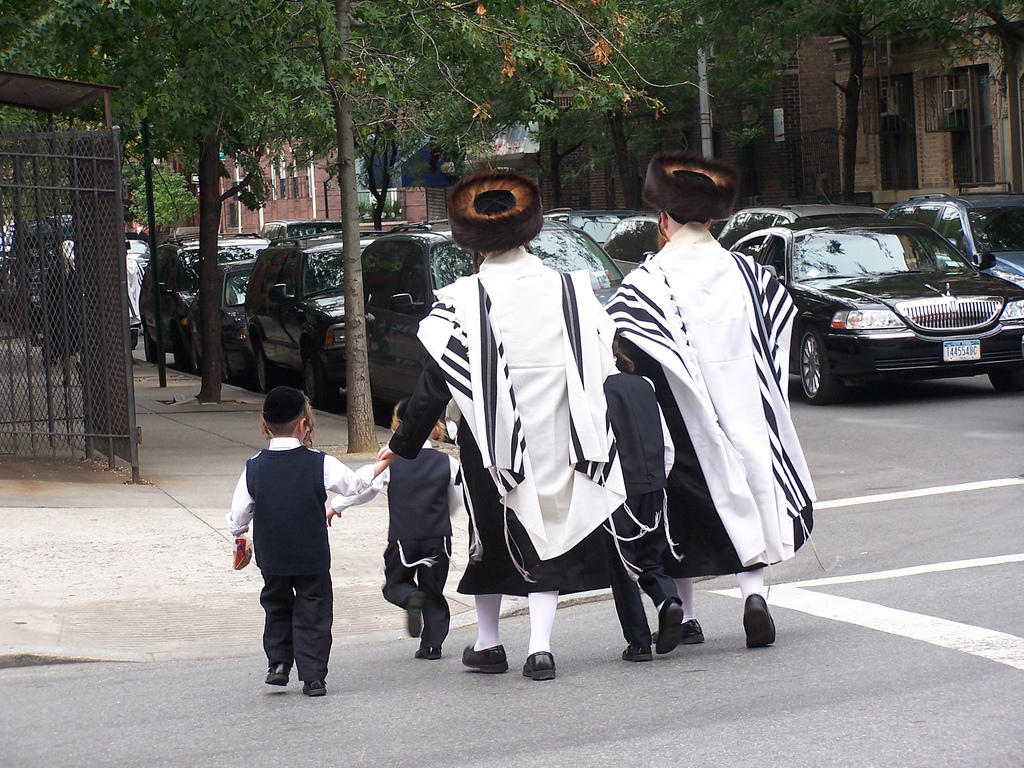
This past weekend, yet another incident of antisemitic violence was caught on camera on the streets of New York. The perpetrator, a white woman who knocked the Hasidic shtreimel off a stranger’s head, demonstrated that antisemitism is fostered in diverse populations in many, diverse ways. But the notion that antisemitic incitement leads to antisemitic violence is beyond dispute—as is the fact that the Times article, riddled with demonization, distortion, and double standards, contributed to the noxious environment of hate that made such a crime imaginable.

Originally published in the Newsweek

Pin It on Pinterest