True Tikkun Olam

Originally published in Jewish Exponent

While we appreciate mention in Joshua Runyan’s column, it appears he has, in theory, confused spurious references to tikkun olam with the genuine article (“In Defense of Tikkun Olam,” Nov. 21).

It is not hard to tell the difference, as our prayer books include this term in the Aleinu prayer said thrice daily: l’taken olam b’Malchut Shakai — to fix the world under the Kingdom of God. What constitutes tikkun olam is not personal whim, but limited to that which realizes Jewish values found in Torah and traditional sources.

Not only do we regard having a positive impact on the world as a Jewish and moral calling, but it is the raison d’etre of our organization.

Rabbi Yaakov Menken

Jewish Continuity Isn’t a Zero-Sum Game

Long-standing journalistic tradition has it that although writers of articles and opinion pieces may suggest titles for their submitted work, editors have full discretion to use titles of their own devising. So one might imagine that Messrs. Cohen, Gussow and Pinker greeted publication of their recent piece in The Forward with some consternation, finding it beneath the inflammatory title, “Does Orthodox Explosion Signal Doom for Conservative and Reform?”

What the authors provided was a thoughtful and cogent demographic analysis of the Jewish community, divided into three relevant groups: the Orthodox, the liberal movements (Conservative, Reform, and smaller denominations), and the “nondenominational” Jews. Among their conclusions are the following:

The number of middle-aged Jews in 2045 or so is destined to be smaller than it is today… We have a surge of nondenominational Jews in their 20s, possibly owing to the fact that so many children of Reform and Conservative parents have eschewed their childhood denominational identities… At least until now, the nondenominational Jews are far from reproducing themselves. Accordingly, they are destined to decline some decades down the road — unless their numbers are replenished by “dropouts” from the religious denominations.

But the truly startling situation is among Conservative and Reform Jews… If current trends continue, then, in 30 years, we’ll see about half as many Conservative and Reform Jews age 60-69 as we have today. And the number of Conservative and Reform children do not reverse the decline.

Turning to the Orthodox, we find wildly different trends. While just 40,000 are in their 60s, we have triple their number — 120,000 — in their 30s. And, perhaps even more astounding are the number of kids aged 0-9. They amount to 230,000 — over five times the number of people in their 60s.

They bring their data to life with the following contrast:

Metaphorically, every 100 Conservative and Reform Boomers have only 56 photos of Jewish grandchildren in their wallets (or smart phones)… If 100 Orthodox grandparents gathered in shul, they could show their friends photos of 575 grandchildren on their smart phones (but not on Shabbat, of course).

Yes, you read that correctly. The Orthodox are projected to have ten times the number of Jewish grandchildren, and to grow six times as large in two generations — while the liberal population is sliced nearly by half.

The data does “tell a jarring story” — simply that the two communities are heading in opposite directions, and at an accelerating rate. That, however, has no relevance to the chosen title hanging over this important content.

The Forward must engage its readers and entice them with catchy headlines, and it is a journal not known for its fondness for the beliefs or practices of observant Jews. But there is something uniquely unseemly about a title implying that Orthodoxy’s gains are somehow related to Conservative and Reform’s losses. One cannot determine whether the editor imagined a thriving Orthodox community to be merely an indicator of liberal decline, or a causative factor — as the article beneath that headline utterly contradicts either implication.

It was once true that there was an inverse relationship between Orthodoxy and liberal Judaism; at that time, immigrants worked on Shabbos (in an era where one was likely to lose a job otherwise) yet prayed in Orthodox synagogues — but their children turned primarily to the Conservative movement. So the decline in Orthodoxy contributed to the rise of the Conservatives, making the latter the dominant American movement for much of the twentieth century. The next generations moved yet further to the left, such that the Reform peaked in the 1970s or 80s.

Intensive Jewish education and commitment reversed Orthodoxy’s decline; today neither an Orthodox nor liberal upbringing feeds into the other in significant numbers. Although it may be true that many Jews from non-Orthodox families adopt Jewish observance each year, their numbers are at most a minor factor in the decline of the non-Orthodox movements. Cohen, Gussow and Pinker don’t even mention this aspect. And, perhaps tellingly, those who drop out of observance after obtaining a day school education rarely join either of the liberal movements. So the growth of Orthodoxy and decline of liberal Judaism are independent phenomena.

Not only are the Orthodox not contributing to the implosion of liberal Judaism, but they are in the forefront of efforts to hold it back. Among the identity-enhancing Jewish activities suggested by the authors are several in which Orthodox Jews help to inspire non-Orthodox youth and young adults: Jewish day schools, Chabad on campus, Hillel, and trips to Israel. Olami on campus and Orthodox-run websites like Aish.com, Chabad.org and Torah.org are but a few other examples. While Orthodox teachers and guides in these programs would readily agree that full Jewish observance might be the ideal outcome, they would also tally anyone who commits to building a Jewish home as a “success,” and acknowledge that this is the far more likely outcome of their efforts.

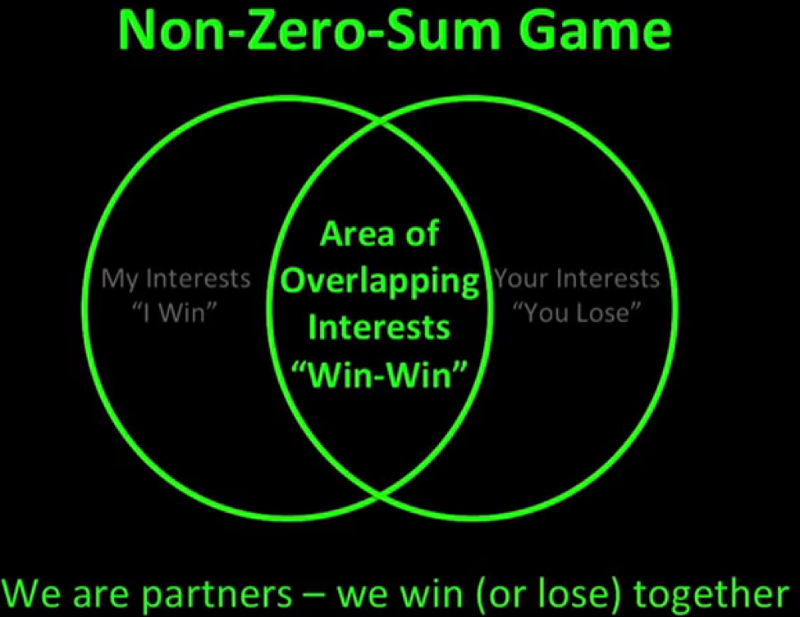
The American Jewish population is not a zero-sum game; one community’s failure to perpetuate itself cannot be blamed upon the other. Several of the reasons for Orthodoxy’s burgeoning growth were beautifully described by Avital Chizhik-Goldschmidt in her op-ed which appeared the same day — none of these come at the expense of liberal Judaism. If the prognosis for Conservative and Reform Judaism is “doom,” it is not because of Orthodoxy, but despite Orthodox efforts to help their more liberal brethren to stanch their losses.

President Trump Is Right, Again

President Trump was roundly criticized for failing to call out neo-Nazis or the KKK by name in his first statement on the tragic violence in Charlottesville last weekend. Even many others in the GOP, including Marco Rubio and Orrin Hatch, indicated that the President should have been specific.

Yet the fact that the planned rally turned into a very two-sided violent melee is undeniable. And here’s what the President said:

We condemn in the strongest possible terms this egregious display of hatred, bigotry and violence on many sides, on many sides. It’s been going on for a long time in our country. Not Donald Trump, not Barack Obama. This has been going on for a long, long time. It has no place in America. What is vital now is a swift restoration of law and order and the protection of innocent lives. No citizen should ever fear for their safety and security in our society.

The words others found offensive were: “on many sides.” Why, they demand, didn’t the President immediately condemn the neo-Nazis and the KKK by name? When pressed on this, the President replied:

“What about the ‘alt-left’ that came charging at, as you say, the ‘alt-right’? Do they have any semblance of guilt?”

The President is right. The presence of odious hate groups on one side does not excuse violence by hate groups on the other. But the left prefers to pretend that left-wing hate doesn’t exist, rather than addressing it.

Maxine Waters responded to the President by tweeting, “No, Trump. Not on many sides, your side.” This is both factually wrong and profoundly dangerous.

The problem with condemning the Nazis or KKK is that it is simply too easy. Just days earlier, a friend and colleague criticized a particular organization as being so weak that it could make no public comment on any issue “except to condemn Hitler.” The only people who don’t regard Nazis as evil are other Nazis.

The question which we should be asking is: why is the left whitewashing Black Lives Matter (BLM) and Antifa?

Of all these groups, the Neo-Nazis, the KKK, BLM and Antifa, which one called for violence against police, which manifested itself in shootings of law enforcement officers in Texas and Louisiana? Which of these groups threatens free speech on college campuses in this country, violently preventing students from hearing opposing views?

I don’t know about you, but I consider policies and procedures that facilitate the disproportionate murder of young black men to be racist. And although every police force must police itself and remove racism from within its ranks, BLM’s hateful agitation has not only led to murdered police officers.

In Baltimore, the death of Freddie Gray in April 2015 led to riots and the politically-motivated prosecution of six officers (half of whom were black themselves) for following what was standard procedure at the time. This led to police being afraid to do the aggressive work necessary to get illegal guns off the street before they are used.

The results can only be described as horrific. 2015 was the most murderous year per-capita in Baltimore history, with 2016 coming in second. 2017 is on track to exceed both. And in all three years, young black men have been hugely overrepresented among the victims. A 10-month-old baby nearly died in her car, which remained locked following the murder of her 26-year-old father in May—until a police officer heard her cry.

The fact that the officer was white shouldn’t even deserve mention. The killing fields of Baltimore are a violent white supremacist’s dreamland, thanks to BLM.

But the media won’t talk that way. The left prefers to imagine that BLM is a civil rights movement, solving a real problem. And this is hardly the only example of left-wing “human rights” causes serving as convenient cover for anarchy, hatred and violence.

If we are going to tear down hateful monuments, we should not start with statues of Robert E. Lee, whom most historians consider to be no more racist than many Northerners of his day. We should start with the Arch of Titus in Rome, celebrating the military victories of that Emperor. After all, the Arch focuses specifically upon the plunder of Jerusalem, and the desecration of the treasures of its Holy Temple. It is an indisputable celebration of ethnic cleansing and genocide.

But that is exactly why it should not be removed. We need to remember our history, in order to avoid repeating it.

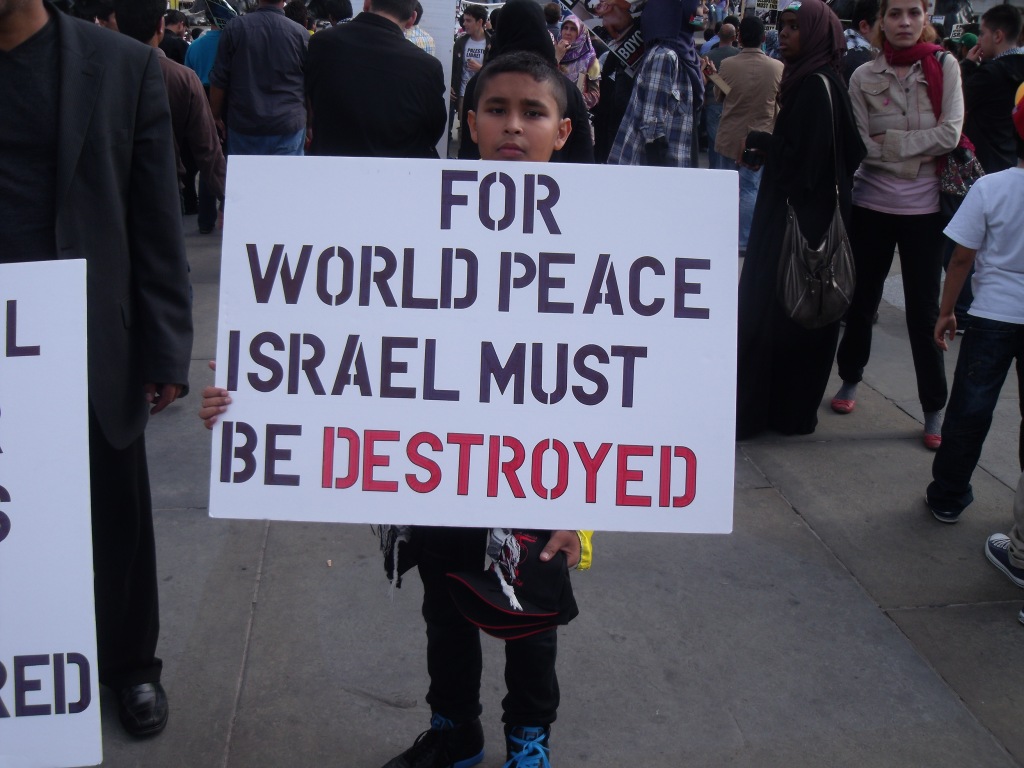
Which of the following statements has incited more murders in 2017: “Heil Hitler” or “Free Palestine”?

Again, the answer is obvious. Everyone knows that Hitler was a Nazi. But all too many people forget that “Palestine” is the name given to the land of Judea by the same hateful invaders who built that Arch, in an attempt to sever the connection between the land and those whose home it truly is. Forget that Palestine is a name birthed from barbarism and ethnic cleansing, forget that it was nothing more than a distant province to its Arab rulers, none of whom possessed it within the past 500 years (save for a brief period of Egyptian control in the 1830s), and you can make “Free Palestine” sound like a civil rights movement.

But what does it really stand for? Consider that there are dozens of unquestioned occupations around the world, in places like Tibet, Chechnya, and even Northern Ireland. But only one call for “justice” is used to justify the murder of children.

There is hatred, bigotry and violence on many sides. It is easy to recognize the hate of 50 years ago; it takes discernment to recognize the hate of today, especially when the left is deliberately masking the hate groups in their midst.

The President should have named all of the hate groups involved, or none. The President was right the first time.

An earlier version of this article was first published in American Greatness, and discussed on the editor’s radio program.

Mandel’s criticism was accurate

Originally published in Cleveland Plain Dealer

Writer Brent Larkin (“For Josh Mandel, no gutter is too deep, no shot too cheap”, Aug 3) faced this choice: address the facts, or write a partisan hit piece. He chose the partisan hit piece.

For consistency, will Mr. Larkin assert that the Coalition for Jewish Values, representing hundreds of Orthodox Rabbis, similarly “sides” with “white nationalists, Nazi sympathizers… and other hate groups?” We independently criticized the Anti-Defamation League “Alt Lite” list as Josh Mandel did, and for the same reason.

The venerable ADL is being dragged off course by a new Executive Director with no experience addressing anti-Semitism and a long pedigree as a left-wing activist. Mr. Mandel’s criticism was accurate and constructive. If Mr. Larkin’s slander is the worst they can find against Josh Mandel, he’ll be an honorable Senator.

Rabbi Yaakov Menken

There is no Israeli ‘Blacklist’ of Rabbis

Originally published in The Washington Post

Regarding Gil Steinlauf’s July 16 Outlook essay, “I’m an American rabbi. Israel rejects my religious authority”:

The false report of an Israeli “blacklist” of rabbis was discredited before the essay was published. More important, Israel balances the needs of diverse religious and secular communities. Rabbi Steinlauf’s claim that the “ultra-Orthodox” have sole control over Jewish “personal-status” matters is pejorative and groundless; Israel uses the same common standards that Jews around the globe have observed for centuries. Rabbi Steinlauf appeared to regard that tradition as outrageous and immoral, yet seemed genuinely surprised that those who revere that tradition might look at his beliefs the same way.

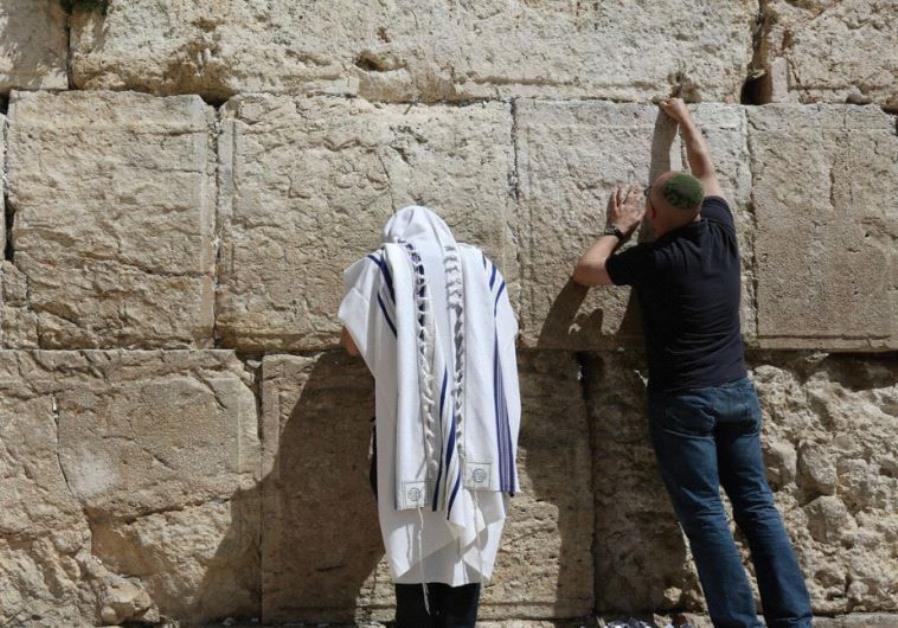
Division at the Western Wall is No Path to Unity

By Rabbi Pesach Lerner and Rabbi Yaakov Menken

The statements from American Jewish movements, the Jewish Agency, and various op-ed writers could hardly have been more repetitive. Following the decision of Israeli PM Netanyahu and his cabinet to suspend the “deal” that would have created a large plaza for mixed prayer at the Western Wall, most rushed to offer opinions no more varied than the news reports, as if there were only one reasonable position that writers (and readers) could take.

Their consistent thesis was that Netanyahu’s decision caved to “political pressure” from the charedi political parties (universally described as “ultra-Orthodox”) and that suspension of the deal was divisive, a rejection of American Jewry. Pejoratives are not merely mean-spirited and divisive in their own right; in this case, they were used to upend the reality.

Neither Uri Ariel nor Betzalel Smotrich, MKs of the Jewish Home party, could remotely be described as “ultra-Orthodox.” Yet both wrote a letter to Netanyahu urging that the deal be scrapped; after it was, Ariel said in a prepared statement that “we succeeded in preventing an unnecessary split among the Jewish people and an attack on the social and religious fabric of Israeli society and the Jewish people.”

So which position unites us, and which divides? Each claims to side with unity, but only one can be correct.

Read the full op-ed at the Jerusalem Post.

A Sad Day for American Jewish Media

Originally published on Arutz-7, May 1, 2017

It is indeed a sad day when an article by the editor of a major Jewish publication fully crosses the line in order to adopt an anti-Semitic narrative about Jews and Israel. But when it is the editor of The Forward who expresses her "dread, despair and embarrassment" that Israel avoided extermination in 1967, we can express our disappointment, but few of us are surprised.

She states that as a child, she "truly believed" that Israel's survival was endangered — as if it were simply childish to imagine that "the extermination of Zionist existence" was the Arab agenda. She says that military victory — not the Balfour Declaration, much less the eternal bond between the Jewish People and their homeland — "legitimized Israel’s moral right to exist;" a militaristic, colonialist view entirely foreign to Israeli Jews who lived through the crisis. 

Far from a "disaster for Palestinians," the Six-Day War gave Arabs living in Gaza and Judea (what Jordan called the "West Bank" when they occupied it in 1948) unparalleled opportunities: universities, modern medicine, massive upgrades to infrastructure. It also vastly improved their lives, from a human and civil rights perspective, compared to Jordan, Egypt and any other Arab state. 

It also gave them something else: the opportunity to slaughter Jews, celebrate barbarism, and blame it on "the occupation." Previous atrocities, from the attack upon Petach Tikva in 1886, to the massacre of the Hebron yeshiva and surrounding community in 1929, to the threatened "momentous massacre" of 1948, and the terrorist attacks of the 1950s culminating in the creation of the PLO terrorist organization in 1964, were all recognized as barbaric and evil. Today we are told that, on the contrary, "resistance is not terrorism." The murder of civilians was "indefensible" for the Irish Republican Army and destroyed the Chechen rebellion, although both constituted "resistance" to true and unquestioned occupations of indigenous peoples in their homelands. Yet it is acceptable for "Palestinian" Arabs. Why the difference? Because in this case, the victims are Jews.

A photo caption to Eisner's article asserts that "Palestinians surrender to Israeli soldiers." This is historical revisionism at its finest. Those surrendering to Israeli soldiers in 1967 did not describe themselves as "Palestinian," but rather "Jordanian." But of course, that level of honesty would vacate the claim that "indigenous Palestinians" are under "occupation." 

The name "Palestine" is translated from the Roman Palaestina. It is a name associated with genocide and ethnic cleansing. Hadrian, the Roman Emporer, renamed the land known to its natives as Judea, because the original name made too obvious a connection to its natives: the Jews. 

Who are the "Palestinians?" Arabs, of course. Arabs who cannot pronounce "Palestine" in their language — the only purported indigenous people to lack a home-grown name for their so-called homeland. The same Arabs who colonized the Middle East and Northern Africa from their true homeland, a large expanse known as Arabiyya. After each failed attempt to massacre the Jews of Israel, they engaged in pogroms and ethnic cleansing of Jews from their homes across the Arab world; the majority fled to Israel. Today, Arabs point fingers at the descendants of these Jewish refugees, and accuse them of racism towards Arabs. And Jane Eisner, editor of The Forward, joins their cry.

The "checkpoints" were not built in 1967, nor to promote "apartheid." They exist for precisely the same reason that we endure the humiliation of removing our shoes in order to board an airplane. The barrier and checkpoints were built to stop massacres of Russian refugees at a discotheque and Holocaust survivors at Passover seders — not to mention families out to enjoy a pizza at Sbarro's. Eisner does not condemn any of these atrocities. Instead she implies that there is something evil in trying to prevent them.

To traditional Jews, this is not entirely a surprise. The Forward has consistently favored welfare programs, but only as long as they aren't used by Jews. It incessantly obsesses over people leaving Orthodoxy, and groups that help them leave. Should we be surprised that the editor writes a hit piece against Israel, celebrating the canards of anti-Semitism — and on the day when the Jews of Israel celebrate being spared from death yet again?

O-WOW Calls to End Prayer at the Wall

Originally published in HaModia.

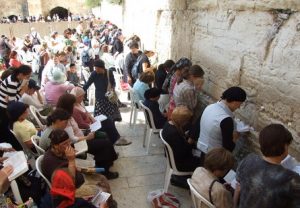
In an unexpected moment of courtroom drama, Dr. Susan Weiss, attorney for the “Original Women of the Wall” (O-WOW), conceded last week what many observers have long recognized: that far from advocating for women’s rights, their agenda is to obstruct observant Jews attempting to pray.

When the “Center for Women’s Justice” filed suit last year on behalf of O-WOW, their stated claim was that the women of O-WOW merely wanted to pray in their own fashion — including reading from a Torah scroll in the women’s section. Preventing them from doing so, they argued, violated Israel’s anti-discrimination laws.

Their day in court revealed a very different interest. Judge Elyakim Rubenstein asked their lead attorney, Dr. Susan Weiss, what sort of alternative site might be acceptable to the group. She replied that in her view, none was necessary. Rubenstein then asked what she would do, were it up to her. She responded:

In actuality, there wouldn’t be a mechitzah (divider) there at all, and I would send all of them to their synagogue. Perhaps I would earmark certain hours for them … It needs to be a public plaza. ‘All of them’ includes both observant women and those women who want to wear tzitzis.

She went on to say that the Wall is not a synagogue, and should not be treated that way. Rather than arguing that women should have Torah scrolls at the wall, she in essence argued that no one should.

Leah Aharoni is co-founder of Women For the Wall (W4W), an organization created by women who pray at the Wall regularly and object to the disturbances created by O-WOW and Women of the Wall. Just recently, W4W requested to join in the case as respondents, because, she said, “they are ignoring the sincere desires of the much larger group that seeks to maintain the tradition of prayer at the Holy Site.”

Regarding Weiss’ statements in court, Aharoni commented that “this confirms what we have said from the beginning, that they are not advocating for women’s rights. Rather, they want to deny observant Jews the ability to pray at the Wall.”

A look back reveals that this is not a new argument. O-WOW is comprised of the majority of the initial, core supporters of Women of the Wall (WOW). And in previous years, Anat Hoffman, head of WOW, suggested herself that her ultimate agenda was to prevent Orthodox prayer at the Holy Site. She told Channel 2 that a day would come when people would look back and say about the Wall, “there used to be a mechitzah here all the time! You don’t believe it.” And before Natan Sharansky proposed a new section, she told a Florida audience that she would be open to “timesharing,” for the Wall to be open six hours a day as a “national monument, open to others but not to Orthodox men.”

Hoffman directs the American Reform movement’s Israel Religious Action Center, described by writer Jonathan Rosenblum as “determined to make life miserable for Torah organizations in any manner possible.” This is entirely in accordance with the expressed interests of both WOW and O-WOW. But the Reform movement — an insignificant minority in Israel, comprised of Jews who do not pray on even a weekly basis — landed upon an even better option: to demand a site equal in size and prominence to the current plaza, used by hundreds of thousands of Jews who pray three times a day.

This is what precipitated the split between WOW and O-WOW. O-WOW’s primary interest is to force their practices upon observant women, while Hoffman now claims that WOW “is the right group for bringing about change in Israel, but not the right group for bringing about change in the Orthodox world.”

The end goal of all three groups — WOW, O-WOW, and the American Reform movement — remains the same: to change the Jewish character of the Jewish State. Hoffman told the BBC that the fight at the Kotel is merely a stepping stone on the path to changing marriage, divorce, and burial in Israel.

Aharoni’s focus, however, remains upon the here and now. She stresses that what O-WOW proposed to the Court is not merely offensive to the observant Jews who stream to the Wall on a daily basis. “For most visitors,” she said, “the idea that they can go to the Wall at any hour of the day or night, any time of the year, and find people pouring out their hearts to G-d … that is a critical part of the experience.”

This experience would be denied to millions of Jews, if the 50 members of O-WOW and WOW were to have their way.

Obama’s Antipathy Towards Israel

In I Maccabees, Shimon is reported to have said, “We have neither taken foreign land nor seized foreign property, but only the inheritance of our ancestors, which at one time had been unjustly taken by our enemies. Now that we have the opportunity, we are firmly holding the inheritance of our ancestors.” (I Maccabees 15:33-34)

The New York Observer today published my piece, which attempts to explain why Obama would go ahead and anger his allies such as Charles Schumer and Alan Dershowitz, and also provoke his successor, who could now prioritize dismantling the Obama legacy.

With Partners Like These…

First published on Israel National News / Arutz-7

Rabbi Shlomo Riskin, the respected Chief Rabbi of Efrat, began his career guiding people towards traditional Jewish observance. Appointed Rabbi of the new Lincoln Square Conservative Synagogue shortly after receiving Smicha (ordination), he quickly persuaded his congregation to drop "Conservative" from both name and practice. Under his leadership, Lincoln Square grew into an early leader in Jewish outreach.

This makes his near-endorsement of a greater Israeli presence for the American Reform and Conservative movements all the more mystifying. While there have been significant changes since he made Aliyah (immigrated to Israel) in 1983, he emphasizes his own “contact with Reform and Conservative Rabbis” – and thus should remain familiar with their activities and outlook.

One might make a credible argument that access to a public Mikvah (ritual bath) in Israel should be open to anyone, regardless of affiliation or intended use. But that was not Rabbi Riskin's claim in a recent interview with Arutz 7. Rather, he suggested one should permit liberal Rabbis to use Mikvaot (for non-Halakhic conversions, no less) because “they're not our enemies, they're our partners.”

To love and pursue peace is a religious imperative. But as the Kotzker Rebbe once quipped, “when truth is discarded, peace is easily achieved.” The sad truth is that the American liberal rabbis and movements are anything but partners.

Most Israelis are unfamiliar with these groups; when they are introduced, they are often dismayed. Israel's current President, Ruby Rivlin, was invited to visit an American Reform Temple when first elected as an MK in 1989. He told the Israeli media afterwards that "as a Jew who does not observe 613 commandments and perhaps not even 13 commandments, I was deeply shocked… I felt as if I were in a church."

Reform leaders objected and professed insult – yet it was not so long ago that the rabbi of New York's Temple Emmanu-El boasted that "a prominent Christian lawyer… told me that he entered this building at the beginning of a service on Sunday morning, and did not discover that he was in a synagogue until a chance remark of the preacher betrayed it."

So are they encouraging similarity to churches, or not? They want to have it both ways; this is a recurring pattern.

Whereas Jewish tradition frowns upon conversion for the sake of a Jewish partner, the Reform and Conservative movements both actively encourage it. In 1983, Reform went yet further, pronouncing the child of a Jewish father to be Jewish – leading to a precipitous decline in those same conversions for marriage. But even if the mother of an intermarried son now believes that she will have Jewish grandchildren, this is usually wishful thinking: children of intermarriage remain unlikely to identify as Jews.

Having seen the failure of patrilineal descent, the Conservative movement refused that change. In most other matters, however, it has followed Reform's lead – with regards to driving on Shabbat, ordaining women, and even same-sex marriage. The average American Reform or Conservative Jew is today so far removed from basic Jewish practices that, comparing Pew Surveys in both countries, Israel's self-defined hilonim (secular Jews) are observant by comparison – more likely to light Shabbat candles, attend a Pesach Seder, or fast on Yom Kippur.

In 2013 the Pew Survey identified 1.8 million Reform Jews in the US, under 1 million Conservative Jews, and just over a half million Orthodox – but if the birth, intermarriage and assimilation rates of the distinct groups continue apace, the Orthodox will constitute the majority within several decades.

Israelis can certainly see the extent to which the American liberal movements strive for partnership. When Anat Hoffman ran for Jerusalem City Council on the Ratz-Shinui ticket in 1989, her platform was one of anti-Orthodox animus so poisonous that even many secular Jerusalemites condemned her advertising as crossing into anti-Semitism.

The Reform movement enabled Hoffman to rebrand herself as an advocate for “women's rights” – primarily the “right” of American liberal women to disturb the prayers of traditional Israeli women at the Western Wall. Her “Women of the Wall” group claims to merely wish to pray on the one hand, while rejecting alternate locations and expressing the desire to change Orthodoxy on the other. The Reform movement, which rejects the unique sanctity of the Holy Temple in Jerusalem and the Western Wall as a site for prayer, finances her efforts.

The movement pays Hoffman to be the director of its Israel Religious Action Center, which Rabbi Jonathan Rosenblum described in 2005 as “determined to make life miserable for Torah organizations in any manner possible.” IRAC delayed the building of a religious center in Rechovot for over a decade despite City Council approval, attempted to prevent Chabad from operating at Ben-Gurion Airport, and recently announced that it will sue ElAl to prevent even voluntarily accommodation for hassidic travelers who prefer not to sit next to someone of the opposite gender.

Yet it is not merely the idea that they are partners with Orthodoxy that must be questioned. The liberal movements believe that they know Israel's needs better than those who live there.

The current head of the Union for Reform Judaism (URJ), Rabbi Rick Jacobs, served on the Board of Directors of the pro-Palestinian J Street, and the ultra-left New Israel Fund. On her American speaking tours, Hoffman deliberately distances her audiences from Israel: she claims that women do not have full civil rights, using Women of the Wall's own antics as her prime example. She also points out that American liberal Judaism – that which rejects the entirety of Jewish tradition – is not accepted by Israel's Chief Rabbinate as authentic Jewish practice. “Israel is way too important,” she concludes, “to be left to Israelis.”

The Reform movement erased the return to Jerusalem and rebuilding of the Holy Temple from its prayer books, yet these same liberal groups now threaten the Israeli government with “rupture” should it fail to transform the Western Wall Plaza, at tremendous cost and irreversible damage to archaeological sites, to meet their demands.

Last week they called for a “show of force” at the Western Wall; it drew less than 100 people. Their American adherents rarely visit Israel – would American liberal Jews care at all, were their leaders not fomenting discord?

They are not partners. They are not partners with Israel, and certainly not partners with Judaism.
Pin It on Pinterest