Exclusion Via Inclusive Language

The Extraordinary World Zionist Congress took place in Jerusalem last week, filling the place of the canceled convention of 2021. As a delegate of the new Eretz HaKodesh slate, I was asked to serve as the Vice Chair of the committee on “Diversity in the Zionist Movement”—and thus I had a ringside seat as leftist voices jammed through a pair of resolutions designed to ignore and exclude Jews who follow the Torah.

The opening plenary featured high-sounding verbiage regarding the unity of the Jewish People, and the need to preserve that unity while allowing for the expression of diverse ideas. Yet the Chair of our committee, a lawyer selected for the purpose, proceeded to discard those opening admonitions. He wrote rules designed to favor one side, rode roughshod over the rules of order, and ensured that the resolutions passed without even a substantive exchange of ideas, much less an attempt to find consensus or common ground.

The resolution concerning “strengthening the relationship between the LGBTQIA communities in the Diaspora and the State of Israel” provided a case study in the misuse of the language of inclusion to enforce ideological conformity and silence dissenting voices. It calls for “education… related to the inclusion of the LGBTQIA community,” and for the World Zionist Organization to join in “Pride Week,” a weeklong celebration of “alternative lifestyles.”

Ensuring the rights of people to behave as they wish does not, and cannot, impinge upon or curtail the rights of others, or demand that others endorse that behavior. To the contrary, genuine liberty allows all of us to behave in ways that others find objectionable. And that is exactly the point.

Proponents of the resolution apparently believe that bringing back eunuchs and female mutilation are actually good ideas, Hashem Yerachem, may G-d have mercy. But these woke policies claim innocent victims, especially once they advocate for men depriving women of scholarships, much less entering their private spaces. Yet the activists deride those women who recognize biological differences and refuse to welcome “trans women” as TERFs—”trans exclusionary radical feminists,” as if there were anything radical about biology or common sense.

This agenda is also entirely tangential, at best, to that of the Zionist Movement, which is to strengthen the Jewish homeland as the national home of all Jews. Israel is already so welcoming to those of diverse orientations and lifestyles that its enemies accuse Israel of “pinkwashing,” using that very tolerance to purportedly mask its so-called persecution of its Arab minority. And, contrary to the resolution’s claim that it is those identified with LGBTQ who need special protection, it is those who refuse to personally celebrate Pride Week who have been persecuted and driven out of business in Israel.

And here is the key issue: in this week’s Torah Reading, the Torah demands of us that Kedoshim Tiyhu, you shall be holy. As Rashi explains, this directs us to withdraw from lewdness and immorality. No Jew who subscribes to the Torah’s dictates will celebrate any form of sexuality, much less a “Pride Week.” Jewish religious schools at all levels teach the value of every person and every Jew, but will not “include” alternative lifestyles as equivalent to or valid methods of building a Jewish home. This resolution thus calls for the exclusion of Jews who follow the Torah from the Jewish Agency and Israel’s other national institutions, via an ideological litmus test.

It is time the “Pride” activists awaken from their delusion: Jews have 3300 years of experience with other groups and governments telling us that our values and beliefs are wrong. Yet we remain Jews, while the Egyptians, Persians, Greeks, Romans, Crusaders, Cossacks and Nazis—and Sadducees, Sabbateans, and Karaites—are all relegated to the dustbin of history.

Hinei Lo Yanum v’Lo Yishan Shomer Yisrael, Behold, the Guardian of Israel neither slumbers nor sleeps. An effort that demands of other Jews that they abandon complete fealty to Torah is doomed to failure. We remain a nation and a people precisely because this is true.

So if they want to put the lie to all their language of unity and ignore the lessons of history, then they can pass resolutions like these. But no one who actually values the unity of the Jewish people can vote for a resolution that requires violating a Torah principle, because Torah cannot and will not be negotiated.

They had the opportunity to hash out language that did not contradict the Torah, while highlighting that Israel welcomes all Jews regardless of beliefs, religious affiliation, or relationships. They blew that opportunity.

So now, only one question remains: in the delayed electronic voting to happen next week, will the World Zionist Congress support an effort with a 3300 year track record of unmitigated failure? Or will they reject a divisive effort railroaded through committee, and instead call for better consideration of all voices at a future conference?

Considering the closed minds of the name-calling left, I confess I do not have high hopes. But I could yet be surprised.

This op-ed first appeared in Israel National News.
Judaism’s Stance on Gender Is Clear, Despite Attempts To Rewrite Torah

As published in Newsweek.

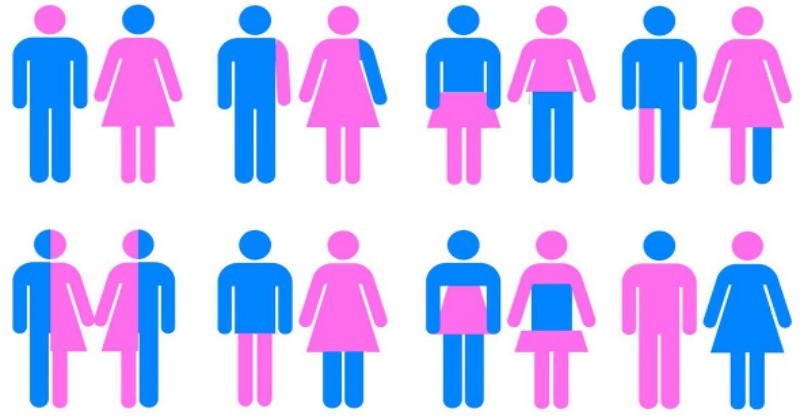
In 2020, various Jewish progressives organized a tendentious campaign of statements, articles, and even rallies insisting that Judaism permits—indeed, demands—unfettered abortion. I observed then that “few things have been said about Judaism by its purported adherents that are more clearly untrue.” Now, following a new wave of opinion pieces and even news articles over the past few months, it seems necessary to add another item to the list: the notion that Judaism recognizes a range—perhaps even a “multiplicity”—of genders.

These claims popped up almost overnight, like mushrooms on a damp field after too much rain. Left-wing clergy, parents of prepubescent children, and even a sitting member of Congress all tried to obscure the obvious and promote the preposterous.

The idea of a “gender identity” distinct from biological sex is, of course, entirely modern. But there is an even more obvious reason why “gender identity” cannot be found in Torah or millennia of Rabbinic literature. Or, it should be obvious, at least, to anyone able to read even the first chapter of the Jewish Bible, in any of the over 700 languages into which it has been translated.

Genesis 1:27 declares (in English translation): “Male and female He Created them.” The following chapter explains that male and female were Created together, and then separated so that husband and wife might rejoin, once again becoming “one flesh” through the forming of their offspring. And that is the sum total of what the Bible has to say about “gender identity:” that men and women are distinct Creations, complementary to each other, each made the way G-d wanted them to be.

What the rabbis still needed to address, of course, were birth defects and other physical aberrations, to understand how affected individuals should observe Jewish laws that differ for men and women. Since the four such phenomena described in the Talmud are mischaracterized by those who now promote modern notions of gender identity, it is worth briefly describing each of them in turn.

A saris is a eunuch, or one who has been castrated. This is the only one of the four examples discussed in the Talmud that could result from either acts of man or acts of nature. For a Jew to do this, however, even to an animal, violates, according to a commonly used 13th-century compilation, Commandment number 291 of the 613 Commandments found in the Torah.

The other three phenomena are all exclusively accidents of birth. An aylonis is a woman who is unable to develop physically, whether due to lacking a womb or a hormonal imbalance. An androgynous exhibits both male and female biological characteristics, and a tumtum, by contrast, has a membrane of skin covering the pubic region, such that his or her sexuality cannot always be determined.

The Talmud records a case of a tumtum who cut the membrane open, and went on to father seven children. Far from being some sort of early transgender procedure, this story proves that a tumtum is indeed of one or the other innate biological sex—it is just that it is masked.

Advocates often latch on to one singular phrase, “Rabbi Yossi says, an androgynous is a Creation of its own” [Bikkurim 4:5], yet, amazingly, do not finish the sentence: “and the rabbis could not prove conclusively if he is man or woman.” In other words, this discussion of a minority opinion makes clear that the determination is an objective one, to be made by neutral judges. The individual’s subjective self-perception is irrelevant; the only question is how he or she was Created by G-d.

This is the sole context of all such Talmudic discussions, which the advocates deliberately ignore. Not only is there no recognition of “gender identity” in Rabbinic literature, but aberrations are neither desirable nor a human choice; rather, they are unfortunate physical defects which legal decisors must address.

As stated at the outset, Judaism teaches that G-d Created male and female so that they might partner with Him in creating a next generation. Surgical and pharmaceutical interventions do not render a woman able to produce sperm or a man able to conceive, gestate, and deliver a baby.

No one can claim with a straight face that procedures resulting in permanent infertility, ongoing medical needs, and shortened lifespans are sanctioned under the moral beliefs of Judaism. All they do is deprive a person of healthy biological function while giving him/her a superficial resemblance to the other gender. Far better for a person to come to embrace what Divine Wisdom has bestowed upon each and every one of us.

Newsweek: The Gray Lady’s Yellow Journalism

At its root, the recent critique of Hasidic schools in The New York Times is not about education, much less “substantial equivalency.” Rather, during a time of increasing antisemitism, with violent incidents centered specifically in Hasidic neighborhoods in the New York area, a pair of Jewish writers decided to engage in deliberate incitement, using stereotypes, exaggerations, and generalizations to portray Hasidic Jews as foreign, money-grubbing, incapable of independent decision-making, and worthy of the hatred directed against them.

Some would say that one cannot accuse a pair of journalists with obviously Jewish surnames of antisemitic bias. But the Talmud teaches that an ignorant Jew hates Jewish scholars even more than antisemites hate Jews; and throughout history, individual Jews have made a name for themselves characterizing old antisemitic canards as present-day truth. The Times writers took aim at Hasidic Jews in a way that the Times itself would loudly denounce as bigoted if done against any other minority community. They not only used the sensationalism, lies, and exaggeration characteristic of yellow journalism but did so while applying ancient tropes to their current targets.

The first belief of the antisemite, per an essay from Rabbi Naftali Berlin, dean of the leading rabbinic seminary at the end of the 19th century, is that all Jewish property is somehow ill-gotten gain. What is correct and just for all others is deemed stolen property if it ends up in Jewish hands.

Thus, the Times announced that Jewish parochial schools received $1 billion over four years, rendering them “flush with public money.” Note that this amount is more accurately described as $250 million per year. Then do the math: given the annual per-child cost to operate New York’s public schools and the total number of students sent instead to Jewish schools, the costly decision of parents to send their children to these schools saves the public system over $3 billion per year, meaning the funds invested by government programs in those children is a pittance by comparison.

Still worse, the funding described was overwhelmingly not for educational expenses. A large chunk was one-time COVID relief, given to businesses and nonprofits of all kinds. Another was for busing, given to all schools to reduce accidents and fatalities on city streets. And a third was for the federal universal school lunch program, which is astounding: a program for the benefit of every American child was portrayed in the Times as the pilfering of public funds when the recipient children were Hasidic Jews. This is undeniably the antisemitic trope outlined by Rabbi Berlin over a century ago.

Corporal punishment is still permitted in 19 states and was far more common until recent decades. Yet the Times reporters reached back into time, describing incidents that happened in all schools as if they were transpiring today—and uniquely in Hasidic ones. As with its specious claim regarding funding, NYPD statistics and testimonies of recent graduates demonstrate that the Times has it squarely backwards: Hasidic schools are much safer environments, where a child is vastly less likely to be the victim of any sort of violence than a peer in the public schools.

To claim that graduates are unprepared, the Times looks not at average income, the relevant metric, but at the poverty line, because that bar is higher with each added family member. Unbelievably, the Times used family size to assert inadequate education.

An obvious implication from the Times is that Hasidic parents are monolithic and incapable of independent thought, their children corralled into these schools. Despite the writers’ obvious awareness that Hasidic schools are either completely independent or tied to one Hasidic leader, they paint with a broad brush, declaring that “the Hasidic Jewish community has long operated one of New York’s largest private schools,” as if all were the same, and jointly responsible for the standards of one school. This sort of stereotyping is considered repugnant when used against any other community. Why is it acceptable here?

It is also preposterous, as each couple chooses a particular community and invests many thousands of dollars per child per year in the schools they select. The Times interviewed a single, non-custodial malcontent while ignoring the hundreds of thousands of satisfied parents who wrote letters demanding that they and not government choose the curricula for their children. This is not legitimate journalism.

Yet the foregoing is merely a sampling of the illogical and classically biased formulations used by the Times writers to target Hasidic schools. What is most appalling, though, is that these very schools are, by neutral standards, setting a standard of excellence that other New York schools would do well to try to emulate. George Washington, Thomas Jefferson, and Martin Luther King, Jr. all said that the primary goal of education is not to memorize the state capitals or even multiplication tables, but intellectual and moral development.

Hasidic school alumni are not found in bars, on street corners, or participating in smash-and-grab robberies. They are homeowners and taxpayers, who build stable families and work to provide for them. Even the Times admitted, in a backhanded fashion, that drug or alcohol addiction, a recurrent aftereffect of leaving the community, is practically unheard of among the great majority who remain. They remain committed to education throughout their lifetimes; their homes are filled with books rather than flat-screen TVs. One would have to do tremendous harm to these schools for their preparation of students for productive adulthood to be “substantially equivalent” to that of the New York City public school system.

This past weekend, yet another incident of antisemitic violence was caught on camera on the streets of New York. The perpetrator, a white woman who knocked the Hasidic shtreimel off a stranger’s head, demonstrated that antisemitism is fostered in diverse populations in many, diverse ways. But the notion that antisemitic incitement leads to antisemitic violence is beyond dispute—as is the fact that the Times article, riddled with demonization, distortion, and double standards, contributed to the noxious environment of hate that made such a crime imaginable.

Originally published in the Newsweek

The Gray Lady’s Yellow Journalism

Originally published in Newsweek

At its root, the recent critique of Hasidic schools in The New York Times is not about education, much less “substantial equivalency.” Rather, during a time of increasing antisemitism, with violent incidents centered specifically in Hasidic neighborhoods in the New York area, a pair of Jewish writers decided to engage in deliberate incitement, using stereotypes, exaggerations, and generalizations to portray Hasidic Jews as foreign, money-grubbing, incapable of independent decision-making, and worthy of the hatred directed against them.

Some would say that one cannot accuse a pair of journalists with obviously Jewish surnames of antisemitic bias. But the Talmud teaches that an ignorant Jew hates Jewish scholars even more than antisemites hate Jews; and throughout history, individual Jews have made a name for themselves characterizing old antisemitic canards as present-day truth. The Times writers took aim at Hasidic Jews in a way that the Times itself would loudly denounce as bigoted if done against any other minority community. They not only used the sensationalism, lies, and exaggeration characteristic of yellow journalism but did so while applying ancient tropes to their current targets.

The first belief of the antisemite, per an essay from Rabbi Naftali Berlin, dean of the leading rabbinic seminary at the end of the 19th century, is that all Jewish property is somehow ill-gotten gain. What is correct and just for all others is deemed stolen property if it ends up in Jewish hands.

Thus, the Times announced that Jewish parochial schools received $1 billion over four years, rendering them “flush with public money.” Note that this amount is more accurately described as $250 million per year. Then do the math: given the annual per-child cost to operate New York’s public schools and the total number of students sent instead to Jewish schools, the costly decision of parents to send their children to these schools saves the public system over $3 billion per year, meaning the funds invested by government programs in those children is a pittance by comparison.

Still worse, the funding described was overwhelmingly not for educational expenses. A large chunk was one-time COVID relief, given to businesses and nonprofits of all kinds. Another was for busing, given to all schools to reduce accidents and fatalities on city streets. And a third was for the federal universal school lunch program, which is astounding: a program for the benefit of every American child was portrayed in the Times as the pilfering of public funds when the recipient children were Hasidic Jews. This is undeniably the antisemitic trope outlined by Rabbi Berlin over a century ago.

Corporal punishment is still permitted in 19 states and was far more common until recent decades. Yet the Times reporters reached back into time, describing incidents that happened in all schools as if they were transpiring today—and uniquely in Hasidic ones. As with its specious claim regarding funding, NYPD statistics and testimonies of recent graduates demonstrate that the Times has it squarely backwards: Hasidic schools are much safer environments, where a child is vastly less likely to be the victim of any sort of violence than a peer in the public schools.

To claim that graduates are unprepared, the Times looks not at average income, the relevant metric, but at the poverty line, because that bar is higher with each added family member. Unbelievably, the Times used family size to assert inadequate education.

An obvious implication from the Times is that Hasidic parents are monolithic and incapable of independent thought, their children corralled into these schools. Despite the writers’ obvious awareness that Hasidic schools are either completely independent or tied to one Hasidic leader, they paint with a broad brush, declaring that “the Hasidic Jewish community has long operated one of New York’s largest private schools,” as if all were the same, and jointly responsible for the standards of one school. This sort of stereotyping is considered repugnant when used against any other community. Why is it acceptable here?

It is also preposterous, as each couple chooses a particular community and invests many thousands of dollars per child per year in the schools they select. The Times interviewed a single, non-custodial malcontent while ignoring the hundreds of thousands of satisfied parents who wrote letters demanding that they and not government choose the curricula for their children. This is not legitimate journalism.

Yet the foregoing is merely a sampling of the illogical and classically biased formulations used by the Times writers to target Hasidic schools. What is most appalling, though, is that these very schools are, by neutral standards, setting a standard of excellence that other New York schools would do well to try to emulate. George Washington, Thomas Jefferson, and Martin Luther King, Jr. all said that the primary goal of education is not to memorize the state capitals or even multiplication tables, but intellectual and moral development.

Hasidic school alumni are not found in bars, on street corners, or participating in smash-and-grab robberies. They are homeowners and taxpayers, who build stable families and work to provide for them. Even the Times admitted, in a backhanded fashion, that drug or alcohol addiction, a recurrent aftereffect of leaving the community, is practically unheard of among the great majority who remain. They remain committed to education throughout their lifetimes; their homes are filled with books rather than flat-screen TVs. One would have to do tremendous harm to these schools for their preparation of students for productive adulthood to be “substantially equivalent” to that of the New York City public school system.

This past weekend, yet another incident of antisemitic violence was caught on camera on the streets of New York. The perpetrator, a white woman who knocked the Hasidic shtreimel off a stranger’s head, demonstrated that antisemitism is fostered in diverse populations in many, diverse ways. But the notion that antisemitic incitement leads to antisemitic violence is beyond dispute—as is the fact that the Times article, riddled with demonization, distortion, and double standards, contributed to the noxious environment of hate that made such a crime imaginable.

Photo Credit: Wally Gobetz on Flickr

Jewish Progressives Are Dead Wrong About ‘Abortion Justice’

Originally published in Newsweek

The “Jewish Rally for Abortion Justice” is set to take place today in Washington, D.C. Led by the National Council of Jewish Women (NCJW), the list of rally sponsors includes the ADL, Hadassah, Hillel and several Jewish Community Centers and Jewish Community Relations Council chapters. Rabbinic, cantorial and synagogue associations of all major Jewish-American denominations will be represented, with one glaring exception: those of the Orthodox.

The stated goal of the rally is to proclaim that “Abortion access is a Jewish value, plain and simple.” Its real goal, however, is to gaslight broad swaths of the country, and to provide cover for secularist elites. The rally’s organizers, sponsors and supporters wish to render the killing of a fetus a religious liberty “right” and, at the same time, promote the dangerous fiction that a rational pro-life position violates the “separation of church and state.”

In situations where termination of pregnancy is necessary to save the mother’s life, it would be offensive to claim that such a basic humanitarian concern is uniquely tied to a particular religion. Is chemotherapy a “Jewish value?” What about access to X-rays or organ transplants? The panoply of sponsors, then, are not addressing the actual underlying debate. They are rallying to demand, in the name of religion, elective feticide until the moment of birth.

According to a didactic tale, a well-meaning person once asked a rabbi, “If you were to bless a pig, would that make the animal kosher?” “No,” the rabbi replied, “but it would make me trayf (not kosher)!” Jewish values are not determined by an alphabet soup of Jewish organizations, but by an immutable and transcendent code of Jewish spirituality, ethics and law. And that Jewish code is clear that life and the soul precede birth. In Genesis, for example, Rebecca is told that her unborn twins have distinct natures (25:23). In the Prophets, G-d informs Jeremiah, “Before I placed you in the womb I knew you, before you left the uterus I sanctified you, I appointed you a prophet to the nations” (1:5).

Moreover, Jewish tradition insists upon adherence to the Oral Law, in which the Mishnah provides moral instruction that a mother must be saved even at the expense of her child, if necessary, “because her life precedes his life” (Ohalos 7:6). Read that again, because the NCJW, the lead sponsor of the rally, refers to this Mishnah without quoting its explicit reference to the “life” of the fetus. Inexplicably, in the same paragraph, NCJW claims that, under Jewish law, a fetus is “not yet having [a] life of its own.”

This is shocking, and shameful. Still worse, other major Jewish organizations and even “rabbinic” groups signed on as rally sponsors, despite the NCJW’s perversion of an obvious statement in Jewish law.

Every citizen has a democratic right to advocate a public policy position, but it is wrong to misuse or mistakenly invoke the First Amendment. Unfortunately, many American Jews have so utterly lost sight of that which Judaism holds dear that they have elevated their own progressive agenda to the level of faith, likely to fill a resulting spiritual void. This rally, led by those who cherry-pick, decontextualize and distort Jewish law to support their position, will draw from those ranks. As mentioned earlier, no Orthodox organization will be at the rally.

This dichotomy between authentic Judaism and idolization of the progressive platform manifests itself in other ways, as well. In several weeks, the Jewish world will celebrate the 3,334th anniversary of G-d’s giving of the Torah to Moses on Mount Sinai. Jews who faithfully adhere to the Mishnah’s teachings will pray in synagogues around the world, celebrating what we believe to be G-d’s greatest gift. Yet, even conceding that I have no special talent for predicting the future, it is quite certain that not 5% of the attendees at the “Jewish Rally for Abortion Justice” will fully observe this annual festival of Shavuot.

Even holding faith aside for a moment, common sense should also have its say. Visit a neonatal ICU, and you will meet babies who cannot yet breathe on their own or ingest nutrients. Yet they are learning to recognize and find comfort in familiar voices, music and their own thumbs. Doctors and nurses work around the clock to ensure that these babies go on to live normal lives. It is utterly nonsensical to argue that a fetus, in precisely the same situation during a routine pregnancy, is not alive.

The transparent and patently dishonest message of the “Jewish Rally for Abortion Justice” is that valuing life is neither a matter of common sense nor an American principle, but rather a parochially Christian tenet—and, further, a tenet that constitutes a violation of the much-ballyhooed “separation of church and state.” Balderdash. In fact, the sanctity of life and the importance of traditional morality both come directly from the Hebrew Bible. Thus, all Americans, especially of the Abrahamic religions, should reject the progressives’ position, predicated as it is upon the absurd notion that it is somehow unconstitutional for the moral values of the citizenry to be reflected in the laws that govern our society.

Rabbi Yaakov Menken is managing director of the Coalition for Jewish Values, a 501(c)(3) non-profit organization that represents over 2,000 rabbis in issues of American public policy. Follow him on Twitter: @ymenken.
Photo Credit: Aditya Romansa at Unsplash.com.

The Torah is Unequivocally Pro-Life

Originally published in Mid-Atlantic Media’s Baltimore Jewish Times, Washington Jewish Times, and Philadelphia Jewish Exponent

A great deal of misinformation has been shared regarding abortion, much of it coming, of course, in the wake of a leaked draft from the Supreme Court suggesting it may soon overturn Roe v. Wade. But everything we have heard about supposed wholesale bans, or lack of concern for the life of the mother, pales in comparison to both the quantity and severity of obviously wrong pronouncements from those claiming a Jewish perspective. One notable organization summed up a common position by stating, “Judaism permits abortion. Full stop.” Few things have been said about Judaism by purported adherents that are more clearly untrue.

The Jewish Bible’s position on life is unambiguous — and emphatically “pro-life.” The Torah identifies human life as a soul placed (breathed) within a body by G-d Himself [Gen. 2:7]. Throughout history, Judaism has opposed murder, child sacrifice and, with only modest exceptions, abortion. It is due to the Torah’s influence that civilized Western society does not accept infanticide as a method of family planning, or regard throwing dissidents to the lions as entertainment.

One who claims that fetal life is not precious to Judaism must not have read the Torah or Prophets, or studied our Oral Law. Rebecca is told not only that she is carrying twins, but that they have distinct natures and characters that explain their behavior in utero [Gen. 25:23]. Jeremiah is told that “Before I placed you in the womb I knew you, before you left the uterus I sanctified you, I appointed you a prophet to the nations” [Jer. 1:5].

And in the Mishnah [Ohalos 7:6] we are taught that the reason one must save a mother even at the expense of her child is “because her life precedes his life.” Some flagrantly misrepresent this as saying that the fetus is not yet considered alive, but the text itself explicitly says otherwise.

Jewish law also demands that the Sabbath be violated in order to save a fetal life. Given that lifesaving activity is the only situation in which Sabbath restrictions are set aside, were a fetus not considered alive this would be prohibited, not required.

Advocates must confront the truth: According to Judaism, abortion, entailing a loss of human life, is an unmitigated tragedy. Even the most permissive opinions reserve abortion for extreme situations that no woman should ever experience. The idea that abortion should be regarded as simply a “choice,” or a routine health care decision when the mother’s health is not abnormally threatened by carrying the child to term, is anathema to our beliefs.

This also, interestingly enough, coincides with all that the medical community has learned about fetal life since 1973. Today we know, for example, that newborn babies respond not only to their mothers’ heartbeats, but to the sound of their parents’ voices. While in utero, babies suck their thumbs for comfort, and even learn music. It is simply nonsensical to argue that a thinking, listening baby is not alive.

Those Jews who ignore our ritual laws, eating pork and treating Saturday like a normal day, rarely insist that the relevant laws were misread or misunderstood. They simply admit they do not follow these laws. But recognizing the Torah’s authority over moral judgments, those wishing to behave in contravention of its ethical precepts often devise tendentious readings to turn prohibited acts into “Jewish values.” Much as we can sympathize with the psychological need behind such efforts, we cannot minimize the inestimable value the Torah places upon all human life, including that of those as yet unborn.

Rabbi Yaakov Menken is managing director of the Coalition for Jewish Values. Follow him @ymenken.
Photo Credit: Marcel Fagin at Unsplash.com.

When “Bigot” Is Projection

Originally published in Times of Israel

Last week, serial entrepreneur and Provocateur-in-Chief Elon Musk tweeted a meme suggesting that the left in this country has veered so far from center that those formerly considered centrists and even moderate leftists are perceived, today, as on the political right. The meme, which went viral, earning more than 1.5 million likes, is essentially the 21st-century version of the statement, “I didn’t leave the left. The left left me.”

That same left was, of course, outraged by Musk’s critique, with Washington Post journalists, NBC media critics, and many others arguing that it is actually the right that has been radicalized. But for all their efforts, incensed pundits and keyboard warriors could not counter the meme’s final, compelling proof: “progressives” now condemn as “bigots” those who maintain a set of values shared not long ago by the overwhelming majority of Americans, and still shared even by many in the center.

As Jews, we can look back at history and find this sadly familiar. We have never conformed to the popular whim, and we don’t today. For example, this past Saturday’s Torah portion contained a passage that is a leading trigger for progressives: “With a man, you shall not lie in the manner that one lies with a woman, it is an abomination” [Lev. 18:22]. Needless to say, this wasn’t a political statement; Acharei Mot was read in every traditional synagogue immediately following the Passover holiday this year, as part of the annual cycle of Torah readings.

For observant Jews, these Five Books of Moses—Genesis through Deuteronomy—constitute the core of what we take to be Divine Law. And because this Law was given from G-d, and, thus, is perfect, we have no standing to second guess what is contained therein. One cannot claim to follow the Torah or Jewish Law, and omit even a single letter. We have survived according to this understanding, and because of this understanding, for millennia.

This dedication to revealed scripture is, further, not unique to Jews. There are literally billions of Christians and Muslims who, today, regard our same Holy Books as arbiters of moral conduct.

Yet according to progressives, it is discriminatory and repugnant to believe the aforementioned verse from Leviticus to be the Divine Writ. According to them, every traditional Jew, Christian, and Muslim is hateful or “homophobic.” Some call for the verse to be “re-interpreted,” while others demand we not “hide behind ancient texts” to justify our purported malice. Where they agree is that our millennia-old beliefs are not merely wrong, but immoral.

No, Jews and others who look to our Bible for guidance are not phobic, but faithful. The bigots are those who condemn us for our beliefs. It is important to state this clearly, to repudiate the gaslighting to which we are being subjected.

What is most notable about this is that only their particular target is new—the notion that “good” people are those who despise our beliefs and practices is ancient. The Bible itself records that Pharoah suspected Jews of disloyalty at a time when nationalism was of the highest value, and that, hundreds of years later, Haman (of the Book of Esther) advocated genocide because the Jews clung to their own beliefs and did not follow those of the King of Persia.

This continued throughout the centuries: temples and synagogues were destroyed and entire Jewish communities were massacred, always because parts of our religious values were deemed to conflict with whatever was au courant in that era. The Third Reich was no exception; Hitler loathed the idea of a conscience, and blamed Jews for “inflicting” such a concept upon Germans.

Thanks to the left, a new definition of hatred has popped up practically overnight. Progressives cannot identify a national leader who, thirty years ago, was not hateful and “transphobic” according to their new standards. Clinton, Obama, and Biden all once opposed gay marriage and other elements of the progressive agenda. Even Bernie Sanders didn’t publicly support gay marriage until 2009. Accusing everyone of hate is neither a tolerant nor a particularly civilized position—it is projection. If you are looking for haters everywhere, the best place to start is in the mirror.

It is important to note that, through 2,000 years of dispersion, Jews have never regarded it as appropriate to impose our beliefs upon any nation or people. This same principle was adopted by America’s founders as a foundational value and, moreover, enshrined in the First Amendment. True tolerance—to not be castigated as deviants, disloyal, malicious, or as phobic “bigots” simply for remaining true to one’s faith and practices—is woven into the fabric of the American ethos.

Sadly, as Musk pointed out, that simple tolerance currently seems too much to ask of those who have claimed the “progressive” mantle. Yet, that tolerance is the genuine, progressive value that, perhaps more than any other, has enabled Americans of diverse beliefs to develop the prosperous nation that has and continues to lead the free world. It is critical that we embrace it once again.

Photo Credit: Tim Pierce, under Creative Commons license

The Washington Post’s Despicable Orthodoxxing

Originally published in Inside Sources

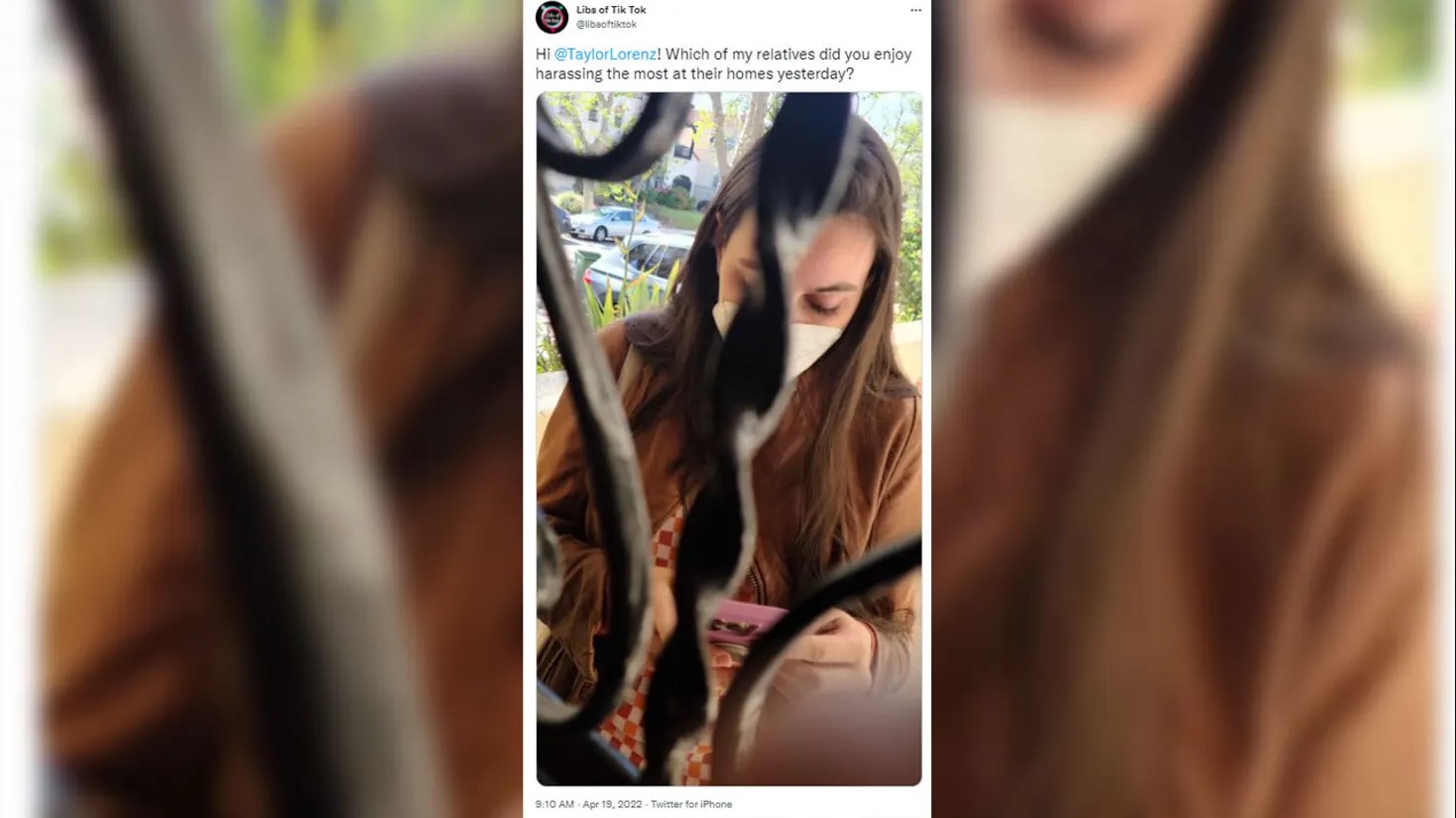
The Washington Post doxxing of LibsofTikTok is viler than it seems on the surface. That is because reporter Taylor Lorenz also thought it acceptable to highlight her victim’s Orthodox Jewish identity, during an ongoing wave of antisemitic hate crimes specifically targeting visibly Orthodox Jews. The writer not only deliberately traumatized her victim but placed her at elevated risk for physical harm. Yet, stunningly, the newspaper defended the practice saying her methods “comport entirely with The Washington Post’s professional standards.”

For those unaware, on Tuesday, in the middle of Passover, Lorenz produced an “exposé” regarding the LibsofTikTok Twitter account. That account, administered anonymously, re-posts videos from Tik Tok users. Whatever one thinks of these videos, they were posted to be shared publicly, mostly by teachers who brag about exposing young children to material their parents might find objectionable. LibsofTikTok merely aggregates them into a central Twitter feed. That is almost all it does.

But according to Lorenz, that is enough for the account to be “impacting anti-LGBTQ+ legislation and influencing millions.” The Washington Post, though its motto is “Democracy dies in darkness,” was apparently troubled by LibsofTikTok bringing its collected videos to light.

Per Oxford Languages, “doxxing” means to “search for and publish private or identifying information about a particular individual on the internet, typically with malicious intent.” Lorenz herself has decried the practice as detestable and dangerous. While writing for The New York Times, she shot a TikTok video objecting to an outlet doxxing an individual by publishing his full name.

Just weeks ago, Lorenz cried her way through an MSNBC interview after she was herself doxxed. “I had severe PTSD,” she said, “I contemplated suicide, it got really bad. You feel like any piece of information that gets out on you will be used by the worst people imaginable to destroy your life.” On Twitter, she wrote simply that “doxxing… [is] not ok in any situation.”

So it is fair to say that as Taylor Lorenz researched and wrote her article, she fully understood the evil of what she was doing.

In her piece, Lorenz did at least three reprehensible things. First, she revealed the account holder’s full name, the very doxxing she decried. She then magnified that hypocrisy by linking to her target’s private real estate license, exposing her work address, and contact information, later removed by The Post as online criticism began to build.

And finally, Lorenz dug through discarded Twitter handles associated with the same account and proudly reported that its holder is an Orthodox Jew.

Of course, the user’s religious identity was no more relevant to curating LibsofTikTok than it was to her work as a realtor. But perhaps it was relevant to Lorenz’s objective.

Consider that Lorenz recently alerted her followers that a woman on Instagram with the same name as her victim is not, in fact, the same person. Fully informed by her own recent experience and the Instagram user’s pleas, she knew the harassers had pounced, yet did not condemn them. She improved their aim.

As a reporter, she also must know that physical violence could well result. According to FBI statistics from 2020, though Jews make up less than 2% of the population, they suffered 55 percent of religiously motivated attacks, more than all other religious groups combined. Those figures precede the further sharp spike in antisemitic hate crimes, particularly against visibly Orthodox Jews. Thanks to Lorenz and The Washington Post, LibsofTikTok spent her Passover holiday “holed up in a safe location.”

And after placing a woman in the crosshairs of certain online harassment and possible physical harm, the newspaper then brazenly and falsely claimed it “did not publish or link to any details about her personal life.” If these actions “comport entirely with The Washington Post’s professional standards,” these standards need an immediate upgrade from someone with a working moral compass.

The Washington Post is an influential newspaper with a venerable past, yet the practices employed to unmask LibsofTikTok violate nearly every one of the elements in the “Minimize Harm” section of the Society of Professional Journalists’ Code of Ethics. It is no wonder Americans’ trust in media is at a near all-time low. If they want to dig themselves out of this ditch, outlets such as The Post must begin acting like they deserve our trust.

This op-ed was also published at The Times of Israel.

Hollywood is using Orthodox Jews as a cudgel to bash all people of faith

Originally published in Washington Examiner

By Rabbi Yaakov Menken and Jonathan Bronitsky

Despite what conspiracy theorists would have you believe, “the Jews” don’t control Hollywood.

Jews might be disproportionately represented in entertainment, but many of them are really just devotees of progressivism, which is hostile to the very principle of national sovereignty (including a Jewish homeland) and all that revealed religion entails.

Orthodox Judaism specifically stands for everything progressives despise. That’s why it has become an additional prime target of the entertainment industry’s unique form of vitriol.

Hollywood has long portrayed Orthodox Jews as hopelessly backward, at best. For instance, a 2005  episode of Grey’s Anatomy featured an “Orthodox” woman who preferred death to a porcine heart valve. (There is no rabbinical issue with such a procedure, by the way. Moreover, the tenet of pikuach nefesh, the preservation of human life, takes precedence over all other commandments in Judaism.)

This plot was echoed years later in an  episode  of the Canadian show Nurses, which had a “Hasidic” family refuse a bone graft for their son because the donor was “an Arab, a woman.” (The episode was later  pulled  due to complaints.) It appears that no one on either production team bothered to do the necessary research or fact-checking in advance, resulting in these entirely unrealistic and not-so-subtly bigoted scenarios.

The American entertainment industry’s most common narrative when it comes to observant Judaism is evident: A life lived in accordance with the Torah is repressive and undesirable, and, accordingly, escaping the despotic clutches of the ancient religion, whether temporarily or permanently, is the path to liberated bliss. Just a few examples:  A Stranger Among Us,  Disobedience,  Arranged,  Unorthodox, and  One of Us .

In Israel, not all portrayals of observant Judaism are so biased. The writer and lead actor of the acclaimed film Ushpizin  earned secular fame and later became observant. The drama series  Shtisel  consults with Orthodox Jews. As a result, Ushpizin and Shtisel offer renderings of Orthodox Judaism that are described by Orthodox Jews as believable. By comparison, the renderings of Orthodox Judaism manufactured by Hollywood are universally regarded by the Orthodox community as slanderous caricatures.

A recent and revealing example of the entertainment industry’s malice is the Netflix television miniseries My Unorthodox Life. Former classmates and others quickly rejected Julia Haart’s dystopian description of her Orthodox upbringing as bogus. In the wake of the sudden collapse of Haart’s stint as the CEO of Elite World Group and her marriage to its owner, it seems that the illustration of her post-Orthodox, secular life was no better. A happy, stable person does not  throw tantrums  when a skinny vanilla latte cannot be obtained at 3 a.m. in Johannesburg. A well-adjusted, blissful person does not  regularly bring staffers to tears.

Yet Netflix acquired My Unorthodox Life and even signed Haart for a second season before the backdrop of her made-for-TV story disintegrated. The streaming service was apparently so besotted with Haart’s representation of Orthodox Judaism as oppressive, and her post-Orthodox life as glorious and empowered, that it was willing, perhaps eager, to overlook many red flags.

Conspicuously absent from American popular culture are positive portrayals of Orthodox Jewish life — specifically stories, whether real or fictional, of people either born into observant homes or secular people who have found their way to faith.

This is no accident. Entertainment studios are the gatekeepers, the formidable arbiters of our national conversation. They choose what gets greenlit and what does not. At a time when Hollywood studios seek to support virtually every minority group, the consistently negative treatment of Orthodox Jews is disturbing, especially during a time of heightened antisemitic violence.

Understand that Orthodox Judaism earns leftist scorn not only because it is traditional in the time-honored sense, but also because it’s a purveyor of traditional approaches to life, marriage, and freedom of conscience. This inexorably places it on what elites pretentiously term “the wrong side of history.” And because Orthodox beliefs and customs are foreign to most people, the average viewer cannot easily differentiate between authenticity and untruth.

Hollywood’s secularist aggression is, of course, not directed exclusively toward Jews. These pernicious depictions are merely one part of a systematic effort by the Left to portray people of faith writ large as primitive and brutish and, therefore, worthy of castigation. The entertainment industry has long attacked Protestant Evangelicals and devout Catholics, labeling them, among other things, “yahoos” and “papists.”

For several reasons, Jews (even observant Jews) once upon a time enjoyed some degree of safe harbor because they weren’t viewed as threatening by those behind the camera. But the wicked abstractions of intersectionality and critical race theory have altered the left-wing calculus, putting the Orthodox increasingly in the crosshairs. Orthodox Jews are now being used as a cudgel to bash all revealed religion, and, by extension, to undermine Western civilization.

What’s to be done? The nonprofit  Jew in the City  is  forming  a “Hollywood bureau” to provide training and media monitoring for producers, directors, and writers wishing to portray Orthodox Jews. Beyond that, but short of launching our own aligned studios, those of us frustrated and concerned must continue to contest Hollywood’s representations of people of faith through both principled argument and virtuous example, exposing these representations in real-time to be what they truly are: malicious fiction.

Rabbi Yaakov Menken is the managing director of the Coalition for Jewish Values . Dr. Jonathan Bronitsky is the co-founder of  ATHOS.

This op-ed was also published at The Jewish Voice.

Permanent Daylight Saving Would Be Disastrous for Jewish Morning Prayer

Originally published in RealClearReligion

When we “spring forward” and “gain” an hour of daylight each March, many of us – maybe most – say to ourselves, “we should have this all year round!” This widespread sentiment was reflected in the Senate’s recent passing of a bill that, if enacted, would permanently place all federal clocks on daylight saving time (DST). As much as it would be nice to get a bit more Vitamin D, especially after being long cooped up because of the pandemic, permanent DST would obstruct many Jewish practices and endanger children and others who must travel to school or work in the early morning hours.

At present, DST is in effect for roughly two-thirds of the calendar year. First put into place over 50 years ago, its goal was to maximize the hours of sunlight during the long days of summer, rather than having the sun rise well before most people do. In the winter, reverting to Standard Time ensured additional light in the morning. With permanent DST, the sun would rise after 8 a.m. for three months or more in dozens of major American cities, and, at its latest, nearly or after 9 a.m. in northern cities like Detroit, South Bend, and Seattle.

America tried permanent DST before, in the 1970s during an energy crisis. Many children across the country were forced to leave for school well before sunrise. I remember, as a third-grader in New Jersey, going out with a flashlight to catch the bus. My mother remembers being petrified, because I insisted that she not come with me to the stop.

Her concerns were hardly unfounded. A number of children were struck by cars while walking or waiting for the bus in the pre-dawn blackness that year. Senator Marco Rubio, who proposed the current bill, may be unaware that eight were killed in his home state of Florida alone. That is why Congress ditched the idea, reverting to Standard Time eight months later.

Even if the safety issues could be resolved, permanent DST would have a significant, detrimental effect on the millions of Americans whose religious practices are tied to the rising and setting of the sun, including Orthodox Jews, who constitute the fastest growing part of the American Jewish community.

Judaism requires being extraordinarily mindful of the clock in a host of areas. One cannot, for example, be a minute late to start observing the Sabbath. Because driving is not permitted during the day of rest, it’s not unheard of for observant Jews to pull over and park on Friday afternoon as the sun sets and walk the rest of the way home.

For Jewish men, the daily morning service, Shacharis, is a time-bound obligation – ideally observed in a synagogue and in the company of at least nine others – during the first quarter of the day after sunrise. That is why permanent DST would prove such an impediment: during the winter months, it would be impossible for those in northern parts of the country to both pray in this fashion and get to work by 9 a.m. Those with early shifts would need to abruptly interrupt their work every morning in order to fulfill their religious obligations in rushed and abbreviated fashion. In turn, they would lose out on much of what is meant to be a spiritual and uplifting beginning to the day.

Doubtless, the move to permanent DST was proposed, as it was in the 1970s, with the best of intentions – to eliminate the disruption of “springing forward” and “falling back,” as well as to save energy. Its implementation, however, would prove especially dangerous to children and severely disrupt religious practices for millions of Americans. It’s now up to the House of Representatives to squash this bill and protect our sacred practices. We must learn from mistakes. As it says in Proverbs 22:3, “The thoughtful saw danger and hid from it, but fools went on and paid the price.”

Rabbi Yaakov Menken is managing director of the Coalition for Jewish Values. Follow: @ymenken.
Photo Credit: Levi Meir Clancy at Unsplash.com.

Pin It on Pinterest

Share This