Podcast: Play in new window | Download
It’s not just idiocy to claim Musk was making a Nazi salute. It’s covering for actual antisemitism, which makes it dangerous.

Executive Vice President, Coalition for Jewish Values & Chief Architect, Torah.org

Podcast: Play in new window | Download
It’s not just idiocy to claim Musk was making a Nazi salute. It’s covering for actual antisemitism, which makes it dangerous.
Podcast: Play in new window | Download
There are few areas where Democrats are more out of touch than with the idea that men should be in women’s sports or prisons.
Podcast: Play in new window | Download
In a misguided effort to appear neutral, America is treating Muslim Jihadis and their supporters more leniently than they would treat anyone else. That, of course, is bigotry.
Podcast: Play in new window | Download
Universities have become indoctrination centers where you go to learn how to ignore humanity’s acquired knowledge.
Podcast: Play in new window | Download
The Biden Administration tried to keep up the impression of supporting Israel and fighting terrorism, but behind the scenes it made the job harder.
Image by Ted Eytan
Originally published in Blaze Media
Amalgamated Bank is one of the smaller and lesser-known U.S. financial institutions, controlling less than $10 billion in assets. Yet it has scored numerous high-powered clients, such as Harris for President and the Democratic National Committee, plus a host of Democratic legislators and candidates.
That’s no coincidence: Amalgamated is a partisan, agenda-driven institution. But given that it is both attempting to gaslight America on hate and trying to interfere with contributions to causes with which it disagrees, Amalgamated’s deep associations and influence within the Democratic Party are not only problematic but dangerous.
Amalgamated presents itself as not merely above reproach but morally advanced. It provided seed funding for the Amalgamated Charitable Foundation, claiming its mission is to “redefine philanthropy,” while, unlike many foundations, it has commingled its leadership, with Priscilla Sims Brown, president and CEO of Amalgamated Bank, also serving as the chairman of the ACF’s board.
It also claims to be in a position to lecture others. Besides operating a donor-advised fund of its own, the ACF also sponsors a campaign called “Hate Is Not Charitable,” directed at other DAF providers. Though it presents itself as reasonable, appropriate, and humanitarian, this campaign is an effort to suppress support for those who oppose Amalgamated’s partisan and even bigoted views.
Donor-advised funds are a common vehicle for donors, desirable for convenience and anonymity. Donors give to a DAF, receive an immediate receipt for their gift, and, over time, instruct the fund to disburse parts of the deposited money to causes of the donor’s choice. Besides permitting donors to schedule tax deductions to maximal advantage, having a DAF write the check means the donor’s contribution to an organization never shows up on the donor’s 1040 or the recipient charity’s Form 990. DAFs routinely reveal the donor’s identity only to the beneficiary; this information is not made public, and thus donors cannot be identified or targeted for the charities that they support.
This is where Hate Is Not Charitable comes into play. Although it claims to be “deeply concerned” that charitable funds can be used to fund “organizations that foment hatred,” Amalgamated’s Hate Is Not Charitable campaign targets other DAFs rather than the organization certifying American charities: the U.S. Internal Revenue Service.
“Donor Advised Fund providers,” Amalgamated intones, “should filter out hate,” but not by using the neutral standards of the IRS, which, of course, DAFs are already required to do. Amalgamated arrogates to itself and its partners the ability to decide whom others should consider hate groups. It knows that if deprived of the anonymity of a DAF, donors could be easily targeted and shamed by Amalgamated’s “empowered” activists for supporting unfavored causes.
Amalgamated claims that Hate Is Not Charitable was prompted, in part, by “white nationalist violence in Charlottesville,” where marching neo-Nazis chanted “Jews will not replace us.” Yet a site search of Amalgamated returns no mention of anti-Semitism in its literature, and it isn’t mentioned as an issue the bank cares about. Instead, the campaign concerns itself with allegedly “anti-LGBTQ groups, anti-Muslim groups, anti-immigrant groups, [and] a white nationalist group.”
Amalgamated’s main resource is the Southern Poverty Law Center. The SPLC’s “Hate Map” is hardly neutral; it was used in a hate-fueled terror attack on the offices of the Family Research Council in 2012. According to the Coalition for Jewish Values, the organization I serve as managing director, the Hate Map is inherently “detrimental and even dangerous to the Jewish community.” The SPLC fails to identify radical Islamic groups as hateful, while besmirching those who confront the dangers posed by those groups as “anti-Muslim.”
The SPLC worked together with the Council on American-Islamic Relations on a 40-page guide to “Hate-Free Philanthropy,” which recommends, among other things, Amalgamated’s Hate Is Not Charitable campaign. CAIR was originally identified as a partner in the Biden administration’s national strategy to counter anti-Semitism, only to be unceremoniously dumped after it blamed Israel for the Hamas atrocities of October 2023, a pogrom that CAIR’s director celebrated with glee.
Amalgamated not only touts CAIR as a charter signatory of its campaign but also gave the organization at least $175,000. And this is far from Amalgamated’s only association with groups inciting anti-Semitism and endorsing terrorism.
Earlier this month, U.S. and Canadian authorities identified Samidoun, an organization that helped organize anti-Semitic protests on American college campuses and the Freedom Plaza protests that called for “Death to Israel,” as a “sham charity” that existed to support the Popular Front for the Liberation of Palestine, a participant in the October 7 attacks. Samidoun is not independent. It is a project fiscally sponsored by the Alliance for Global Justice, a charity that also sponsors campaigns to boycott Israel and other left-wing causes.
According to its own public filings, Amalgamated Charitable Foundation gave over $1 million to AFGJ between 2020 and 2022, the most recent year for which records are available. The Capital Research Center also identifies Amalgamated’s donor-advised fund as a key money conduit for AFGJ. This is especially troubling because, since 2020, credit card companies have blocked donations to Samidoun, and in 2023, several credit providers, including Stripe, PayPal, and Salsa Labs, stopped serving AFGJ directly.
House Ways and Means Chairman Jason Smith (R-Mo.) in September called for the IRS to strip AFGJ of its tax-exempt status due to its role as the sponsor of Samidoun’s efforts “to incite violence and instill chaos.” If Amalgamated truly wanted to fight hate, it would have already cut ties with AFGJ, Samidoun, CAIR, and other organizations that celebrate or sponsor terrorism.
Instead, Amalgamated targets neutral groups to advance its partisan agenda — an agenda partially funded through its financial relationships with major Democratic campaigns and the Democratic National Committee. It’s regrettable that Democratic donors may be unknowingly supporting hate in America, and it’s up to the campaigns to put an end to it.

Originally published in Townhall
Last week, Toyota became the latest major corporation to drop the Human Rights Campaign’s Corporate Equality Index (CEI), and otherwise pull back from the grievously-misnamed regimen of racial bias, intolerance, and antisemitism called “diversity, equity and inclusion” (DEI). Same-sex unions are still outlawed in Japan, so one might think that Toyota is responding to the demands of that country’s more conservative culture. This would be a mistake: rejection of DEI is all-American, and happening because the “Good Ol’ Boys” (and girls) of America’s flyover states, and the common sense thinking they represent, are finally being heard.
As a child, I grew up watching the Dukes of Hazzard; “Good Ol’ Boys” is how singer Waylon Jennings described the protagonists in the theme song. Despite its use of Confederate imagery, the show explicitly eschewed racism—black men appeared as allies of both the Dukes and the corrupt lawmen who chased them. Set in a fictional Georgia county, the show was about a legal system abused to persecute decent, otherwise law-abiding Americans; the heroes were those who fought to stay ahead of the unscrupulous sheriff and town commissioner. Each episode pitted plain, decent, salt-of-the-earth Americans against a biased system.
Life often imitates art. Today, the biased system persecuting the decent is not run by lawmakers, but by organizations that have set themselves up as the arbiters of a redefined morality. The Human Rights Campaign (HRC) and its CEI are Exhibit A.
The pro-LGBTQ+ HRC rolled out its CEI standards in 2002, long before gay marriage was legalized across the country. At that time, HRC merely called for protections for LGBT workers from discrimination and healthcare for same-sex domestic partners. With each victory, though, its agenda became more extreme. Genuine opposition to racism and intolerance has been subsumed under HRC’s demands for ideological conformity and outright bigotry towards traditional faiths and those who practice them.
In the wake of the killing of George Floyd by Minneapolis police, programs celebrating “Diversity, Equity, and Inclusion” (DEI) became the order of the day—and HRC clearly spotted and leveraged an opportunity. The post-George Floyd version of CEI mandates not only hiring for identity rather than talent and gender-neutral dress codes, but for harmful “transgender” surgeries to be standard benefits in a company healthcare plan.
The HRC brags that their “CEI touches every industry and sector,” and that organizations from Disney to Coca-Cola flaunt their scores. Yet CEI means more than insidious social credit: the biggest investment firms reportedly factor CEI scores into a company’s “Environmental, Social, and Governance” (ESG) score, which impacts credit ratings, loans, investments, and overall profits. A company that refuses to bend the knee to the HRC, in other words, may be deemed risky or poorly-managed on that basis alone. It is no wonder that, although only 13 companies met HRC’s modest goals in 2002, 545 caved to all of CEI’s “evolved” requirements found in HRC’s most recent report.
Thankfully, hope is not lost. The people have had enough, and, in words the Dukes used a few times, “they mean business.” The fact that a foreign manufacturer has now heard reason indicates how loud their voice has become.
The trend started with deeply American brands, a short list that HRC targeted on its website for abandoning its CEI: Ford, Jack Daniel’s, Lowe’s, Tractor Supply Co., Harley-Davidson, Molson Coors, and [John] Deere & Co. But now the list has grown so long that HRC lists only three.
It already gave up on Harley-Davidson, for example, a brand with loyalists who approach cult-level devotion. After Harley instituted DEI programs, those fans were smashing their coffee mugs, covering their tattoos, and demanding the motorcycle maker fire its CEO.
Unsurprisingly, Harley responded. It announced that it would no longer report to the HRC, and would henceforth sponsor only motorcycling and community programs.
It turns out that a motivated customer base means a lot more for the bottom line than a good ESG score. Apparently, HRC considers Harley-Davidson a lost cause, at least for the time being.
Similarly, Tractor Supply—a staple brand for American farmers—jettisoned its CEI compliance and sponsorship of pride festivals after customers objected, saying the company will instead “focus on rural America priorities.” Again, HRC has given up for now on reversing Tractor Supply’s course correction.
Now that abandoning the CEI diktat has become a trend, HRC and allies have taken note. But instead of revising their intolerant and divisive agenda, they instead blame “small, well-funded… right-wing activists”—people like Robby Starbuck in particular, a social media warrior with a large following.
This could yet be DEI’s undoing, because Starbuck succeeds only because his message resonates. .
Suggesting that companies hire with zero regard for an applicant’s race, religion, or national origin, much less with whom he or she shares a bedroom, is not a right-wing cause—unless one wishes to argue that right-wingers are the only non-racists in the country.
Image by Alden Jewell on Flickr
Originally published in JNS
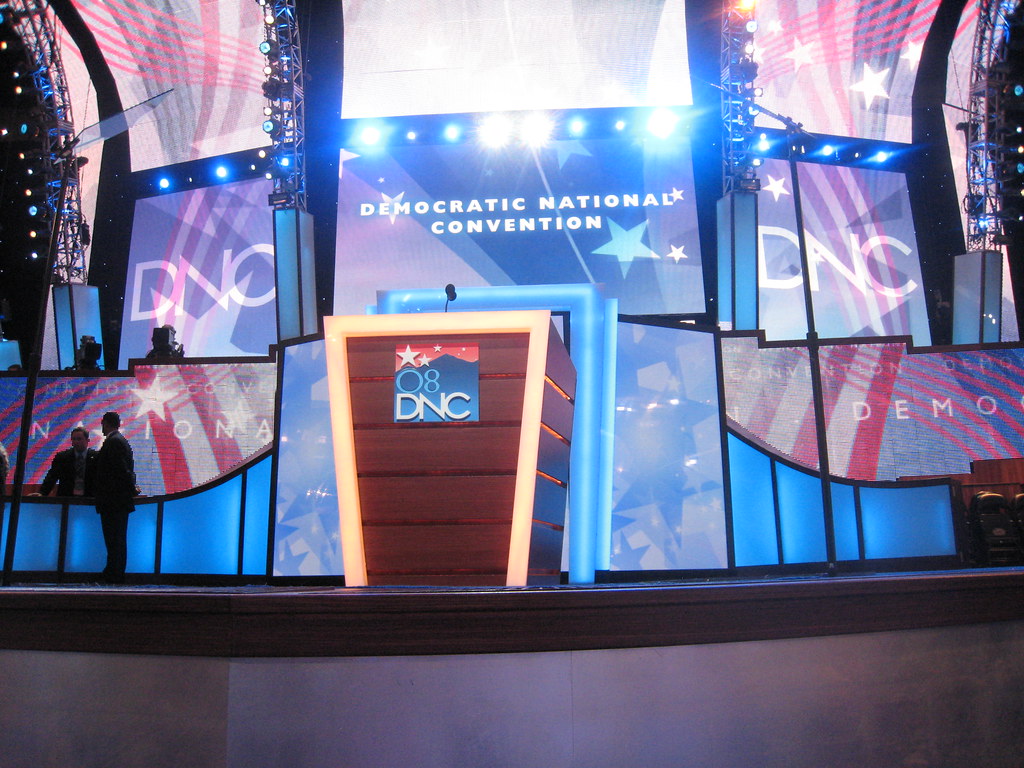
At this writing, businesses in downtown Chicago have been boarding up their windows in preparation for “mostly peaceful” protests during the Democratic National Convention. The purpose of these protests is ostensibly apolitical, given that the protesters intend to oppose the current position of both major American political parties and the Robert Kennedy Jr. campaign: supporting Israel in its battle against a genocidal, antisemitic adversary. The question, though, is whether that will remain the case after the convention—and whether pro-civilization Democrats, not to mention the DNC’s new list of sponsors, will cry foul.
Past conventions have seen a slow but steady decline in support for Israel in the party platform, ever since Barack Obama became the party’s nominee. The 2000 and 2004 platforms declared that Jerusalem “should remain an undivided city” as the capital of Israel; the 2008 version, however, said that although it “is and will remain the capital of Israel,” how it is governed should be “a matter for final status negotiations.”
The 2008 platform was the first to separate “Palestinians” from “Arab leaders.” Critically, it removed the “Palestinian” issue from the context of peace between Israel and her Arab neighbors, when in reality it was the hostility of the Arab League that created the “Israel-Palestinian conflict.” Only in the most current draft platform is there a new reference to “historic normalization” between Israel and Arab states; this is due to the successful Abraham Accords, signed just a month after the 2020 platform emerged.
In both 2004 and 2008, the party expected Palestinian refugees to find permanent homes in a Palestinian state, rather than Israel, and dismissed the notion that Israel might return to the 1949 armistice line as “unrealistic.” These positions disappeared in 2012 in a platform that explicitly referred to Palestinians as a “people” distinct from Jordanian and other Arabs—a claim that Palestinian Authority head Mahmoud Abbas himself would later reject. Despite Abbas’s own words, the 2016 version went even further, claiming that “Palestinians” needed an independent state for their “dignity.” Twice. That year was also the first time the platform declared Jerusalem a “matter for final status negotiations,” saying that it “should remain the capital of Israel” only after making this point.
This did not satisfy the “activists.” Delegates in 2016 flew the Palestinian flag on the convention floor while holding up signs in support of “Palestinian rights;” some said that Palestinian flags outnumbered the American ones. Others burned the Israeli flag outside while calling for violence against Israelis by chanting, “Long live the intifada.”
Perhaps not coincidentally, the 2020 platform was worse, kowtowing to the antisemitic wing of the party. For the first time since 2000, the platform condemned “unilateral actions” but the example given was “annexation” by Israel, rather than a unilateral declaration of Palestinian statehood. The platform maintained previous opposition to the Boycott, Divestment and Sanctions Movement (BDS) as “unfairly” singling out and delegitimizing Israel, yet appended support for “the Constitutional right of our citizens to free speech” as if that were somehow at risk. Since the 2020 convention was held entirely virtually at the height of the COVID pandemic, there was no way to measure the strength of opposition outside in the streets.
Against this backdrop, the newest draft platform might seem a welcome reversal. “The United States strongly supports Israel in the fight against Hamas,” it says, along with “the United States wants to see Hamas defeated.” It touts “a strong coalition to counter and deter Iran,” “stand[s] against incitement and terror,” and seeks a Lebanon “free from the grip of Iran-backed Hezbollah.” It retains support for Israel’s “qualitative military edge,” opposition to BDS—albeit with that “free speech” proviso—and says that Jerusalem “should remain the capital of Israel,” though with that proviso that its governance “is a matter for final status negotiations.”
To call this platform an improvement, however, would be myopic. None of the foregoing positions are actually new, nor do they represent a turn back towards fairness to Israel. Instead, the platform repeatedly focuses upon the needs of the “Palestinian people,” as if “Palestinian” were a descriptor uniquely applied to Arabs. Never mind that this is antisemitic historical revisionism, erasing 2000 years during which, to the contrary, the only people identified as “Palestinian” were Jews.
These new, exclusively non-Jewish “Palestinians” also warrant the platform’s only mention of “food insecurity,” even though the World Food Program USA lists Israel, its territories, and Gaza nowhere among the “10 Countries Suffering the Most From Hunger,” and food insecurity affects tens of millions of Americans even today. It is difficult to explain this without referencing humanity’s long history of inappropriate finger-pointing at Jews.
The platform even disparages former president and current candidate Donald Trump for “refus[ing] to endorse the political aspirations of the Palestinian people,” as if Jordan never existed or Abbas never declared their people to be one and the same. Caring for “humanitarian suffering” in Gaza is appropriate in context, but when the DNC expresses support for a populace distinguished by support for antisemitic massacres to the exclusion of Ebola patients in the Congo, it’s appropriate to wonder what their true priorities are.
And don’t forget: This is merely the draft. Democrats have yet to produce a platform acknowledging that Vice President Kamala Harris is now at the top of the ticket. We also have no idea how many who supported the burning of Israeli flags outside the 2016 DNC might now be seated as delegates inside. The amended platform may be much, much worse.
What has also changed at the DNC is the list of sponsors. With the exception of AT&T, which, with its predecessors, has provided communications services to both major conventions for more than a century, this year’s corporate sponsors all seem to be new. Per The Chicago Tribune, these include United Airlines, McDonald’s, Archer Daniels Midland Co., CME Group, Cboe Global Markets Inc., and Peoples Gas.
It could be that these corporations, whose reputations are newly tied to the actions of this year’s DNC, are the only ones who can step on the brakes, preventing the party from lurching further into anti-Israel and antisemitic territory. It seems unlikely that backhand support for Hamas and genocide is what they signed up for, and they can condition support for the DNC and the Harris campaign upon a platform that—as Israeli Prime Minister Benjamin Netanyahu so aptly put it—favors civilization over barbarism. One can only hope that this will prove to be the case.
Photo Credit: Steve Bott on Flickr
Originally published in JNS
Candace Owens launched into a rant on her YouTube show last week claiming that the Star of David is tied to child sacrifice and black magic. She “explained” that King Solomon, builder of the Holy Temple, had a ring that he used to command demons. All of this, she said, shocked her “to the core” but “if it’s on Wikipedia … that just must mean that it’s such an irreversible fact.”
This was not the first time Owens based one of her wilder conspiracy theories on the ubiquitous online resource. In her opinion, “It’s gotta be true if it’s on Wikipedia.” But endorsing Wikipedia fits neatly into Owens’s new position as a leading promoter of antisemitism because the web-based encyclopedia has what others have called its very own “Jewish Problem.” And unlike Owens, Wikipedia owes much of its spread to its generous connections to Big Tech.
Wikipedia’s antisemitism is practically ubiquitous across the website. It features an extensive article accusing Israel of “war crimes,” “indiscriminate attacks” and “genocide” as Israel seeks to eliminate the Hamas terror organization.
Regarding Hamas itself, however, Wikipedia merely says that “authors have characterized” (emphasis added) the Hamas charter as genocidal, although Hamas leaders themselves repeatedly declare that genocide against the Jewish nation is the group’s very purpose and mission. Instead, Wikipedia claims that the Hamas position regarding Israel has “evolved” from seeking its destruction to seeking its annihilation.
Readers of Wikipedia “learn” on multiple redundant pages that the wholesale expulsion of Palestinian Arabs from Israel is an uncontested fact. Never mind that Robert F. Kennedy documented the pride that Zionists took in Arab immigration, the genocidal intent of the Arab League when it attacked Israel in 1948 and that local Arabs were advised to voluntarily leave their homes until the Jews were exterminated. Yet according to Wikipedia, the real aggressors were unquestionably the Jews.
According to Wikipedia, an “apartheid” state is a Middle Eastern country in which both Jews and Arabs have civil rights, “Palestine” is a country that actually exists and Arabs are natives of the region. Wikipedia also has a long piece celebrating the propagation of this sort of bigotry via “Israel Apartheid Week” with “criticism” of its antisemitic hate relegated to the end.
Wikipedia’s co-founder Larry Sanger abandoned the organization in 2002. As documented on Wikipedia itself, Sanger noted that the site is dominated not by experts with actual, relevant knowledge, but by those who edit most frequently and insistently, not to mention the “trolls.” This is why major universities dismiss Wikipedia as an unreliable source that is unacceptable for academic work.
In June, Wikipedia took its bias to a new level, unironically stating that it considers the ADL an “unreliable” source on the Israel-Hamas War. The statistically impossible casualty counts provided by the Hamas-controlled Gaza Health Ministry, on the other hand, are cited as if they were credible.
The connection between Wikipedia and Big Tech is easy to establish. Though Wikipedia likes to beg regular users for money, its Wikimedia Foundation (WMF) features a who’s who of Big Tech donors: Apple, Google, Facebook, Microsoft, Adobe, Salesforce and more. Besides direct grants from these firms, woke programmers, engineers and other staff at companies like Apple and Google, as well as LinkedIn, Intel and Netflix have used matching gift programs to multiply their contributions.
The truth is that WMF, together with the Wikimedia Endowment, holds over $350 million in assets. This means that with no further donations or investments, Wikipedia can continue operating comfortably for over a century. Yet its relationship with Big Tech has only deepened and diversified.
In 2021, Wikimedia launched Wikimedia Enterprise, providing paid services for companies and organizations that reuse Wikipedia content on a large scale. A routine search using Google, Alexa or Siri often brings you a highlighted result drawn from Wikipedia like the Google “Knowledge Panel” at the top of search results. This is, in part, why a Google search for “apartheid” features recurring instances of antisemitic fiction on its first page of results.
Besides Big Tech, there is one more Wikipedia donor to consider: the Soros-funded Tides Foundation. Tides has also given millions of dollars to groups that instigated and supported the antisemitic protests across America since Oct. 7. This is the company Wikimedia keeps.
Through direct links, integration with Wikimedia Enterprise and generous donations, Big Tech is enabling the spread of antisemitic hatred via the trolls of Wikipedia. Only the same Big Tech firms are positioned to compel Wikipedia to improve its contribution, editing and review processes to demonstrate the commitment to fairness and accuracy that should be the hallmark of any true source of knowledge.
Photo Credit: Nohat on Wikimedia Commons

Originally published in Townhall.com
For years, progressives have insisted that corporations place left-wing goals ahead of core business interests. It turns out that this pursuit of utopia produces negative results that even exceed the expected costs—and those in C-suites would do well to take note before offended customers, and shareholders, hold them to account.
It was always obvious that establishing “DEI” (Diversity, Equity, and Inclusion) positions for those of particular races and newly-redefined genders, prioritizing “diversity” goals over neutral tests of competence, and making cash investments with no foreseeable return were a disservice to investors. But these were expected, even demanded, by activists offering blithe assurances of miraculous benefits that would supposedly make it all worthwhile.
These demands also came, of course, with an unmistakable undertone of “Nice little business you got here. It would be a shame if something were to happen to it.” It has been a massive corporate shakedown—and nothing more than that, producing near-universal harm to companies and their owners.
Consider Robert Kraft, creator of the Kraft Group and the owner who revitalized the New England Patriots. As a committed Jew, he also founded the Foundation to Combat Antisemitism in 2019, which created the hashtag #StandUpToJewishHate and the blue square logo.
Due to his sympathy for the persecuted, it is understandable that Kraft and his Patriots wanted to respond to the George Floyd protests, as well. He should, nonetheless, have seen the writing on the wall.
It was clear from the outset that the leaders of “Black Lives Matter” (BLM) organizations were viciously antisemitic, with one even claiming that humanity is “doomed” if Jews are permitted self-determination. But when the Kraft Family/Patriots Player Collaborative Fund pledged a large sum to fight “systemic racism,” it was accompanied by a tweet and video messages from the Patriots and players promoting the “Black Lives Matter” slogan and the groups behind it.
One can only imagine how Kraft felt to witness the celebratory response of these same Black Lives Matter organizations to the slaughter of Jews by Hamas terrorists last October 7. BLM Grassroots claimed to stand with the “Palestinian people” and characterized the beheading of Jewish babies as “self-defense.” One branch, BLM Chicago, even tweeted out a graphic of a Hamas paraglider, of the sort that descended upon the Nova festival to butcher the pro-peace revelers for being Jews.
Over five years ago, my colleague Rabbi Dov Fischer wrote that he had given up on the NFL. Before October 7, even before George Floyd and BLM, Colin Kaepernick was taking a knee, spitting on the American flag so valued by those financing his over $50 million in earnings. Other players soon joined him, while team owners refused to demand basic decorum and respect. That’s when the NFL lost a life-long fan in Rabbi Fischer—and likely many others who never wrote about it.
The Patriots alienated thousands of fans by supporting the players who denigrated the flag, and by supporting an antisemitic movement that rejoices in the killing of Jews. Surely Kraft regrets that now, but how is he going to repair his team’s relationship with those fans?
Or consider Patagonia, which, in pursuit of environmental causes, contributed generously to the Alliance for Global Justice (AfGP). Patagonia denied knowing that AfGP was in turn funding Samidoun, a group known to Israel as a subsidiary of the Popular Front for the Liberation of Palestine (PFLP) terror organization. When not financing hijackings and murder in the Middle East, PFLP, through Samidoun, also helped organize the antisemitic protests and encampments now plaguing campuses across America.
So Patagonia, which declares its aversion for discrimination of any kind, helped fund the murder of Israelis and efforts to drive Jews out of American academia. How did this enhance Patagonia’s business, or its relationship with investors and consumers? Did the encampers line up to buy Patagonia sleeping bags?
And then there’s Tractor Supply, a national home improvement and agriculture chain based in Tennessee. One wonders how much pressure it took before the firm agreed to emphasize “diversity, equity, and inclusion” (DEI) and fighting climate change over selling good products at a good price.
Following an entirely-predictable backlash, the company backtracked. It announced that it will eliminate all DEI positions and, notably, stop sharing data with Human Rights Campaign, a non-profit that pushes for hiring LGBTQ+ individuals regardless of qualifications. And now it finds itself targeted by its erstwhile allies.
Tractor Supply has faced extraordinary criticism because it didn’t merely bow to the left before backing away. Rather, it loudly proclaimed its allegiance to the woke agenda, declaring that failing to cut emissions or hire more DEI-approved candidates would pose a “significant threat to its business.” And then, later, it realized that its job was to “ensure our activities and giving tie directly to our business.” Agitators correctly took this as a direct repudiation of the left-wing agenda Tractor Supply once heartily endorsed, and are apoplectic that the company now acknowledges their emperor had no clothes.
The hypocrisy is blatant. Americans realize that diversity is great, but DEI, with its emphasis on dividing people into racial and ethnic boxes, is not. So Tractor Supply is staying with its new, truly race-blind approach, and companies like John Deere and even Microsoft are following suit.
The best approach, then, is to dispense with DEI, antisemitic, and anti-American policies, activities, and investments as quickly and quietly as possible. Companies should follow the model of Jonathan Isaac, instead. Despite missing nearly three full seasons due to injuries, Isaac was recently offered, and accepted, a five year contract extension with the Orlando Magic—for $84 million.
As much as he is a fantastic defender on the court, Isaac also distinguished himself by refusing to take a knee, meaning he never alienated fans like Rabbi Fischer. It turns out that fans would rather watch players they admire for more than their skills, which is why Isaac is celebrated while Kopernick made himself “toxic” to the NFL.
Corporate support for charity and opposition to discrimination are laudable, of course—when funds are given to causes all support, and the aims are truly color-blind. There are poor children that need a good meal, schools that need textbooks, and diseases that need cures. And, of course, all job candidates deserve an equal shot for hiring and promotion based upon their skills and talents alone. It’s not hard, then, for corporate offices to reject partisan, political agendas—much less for causes that many Americans find offensive, even evil—that will only harm the bottom line.
Rabbi Yaakov Menken is managing director of the Coalition for Jewish Values.